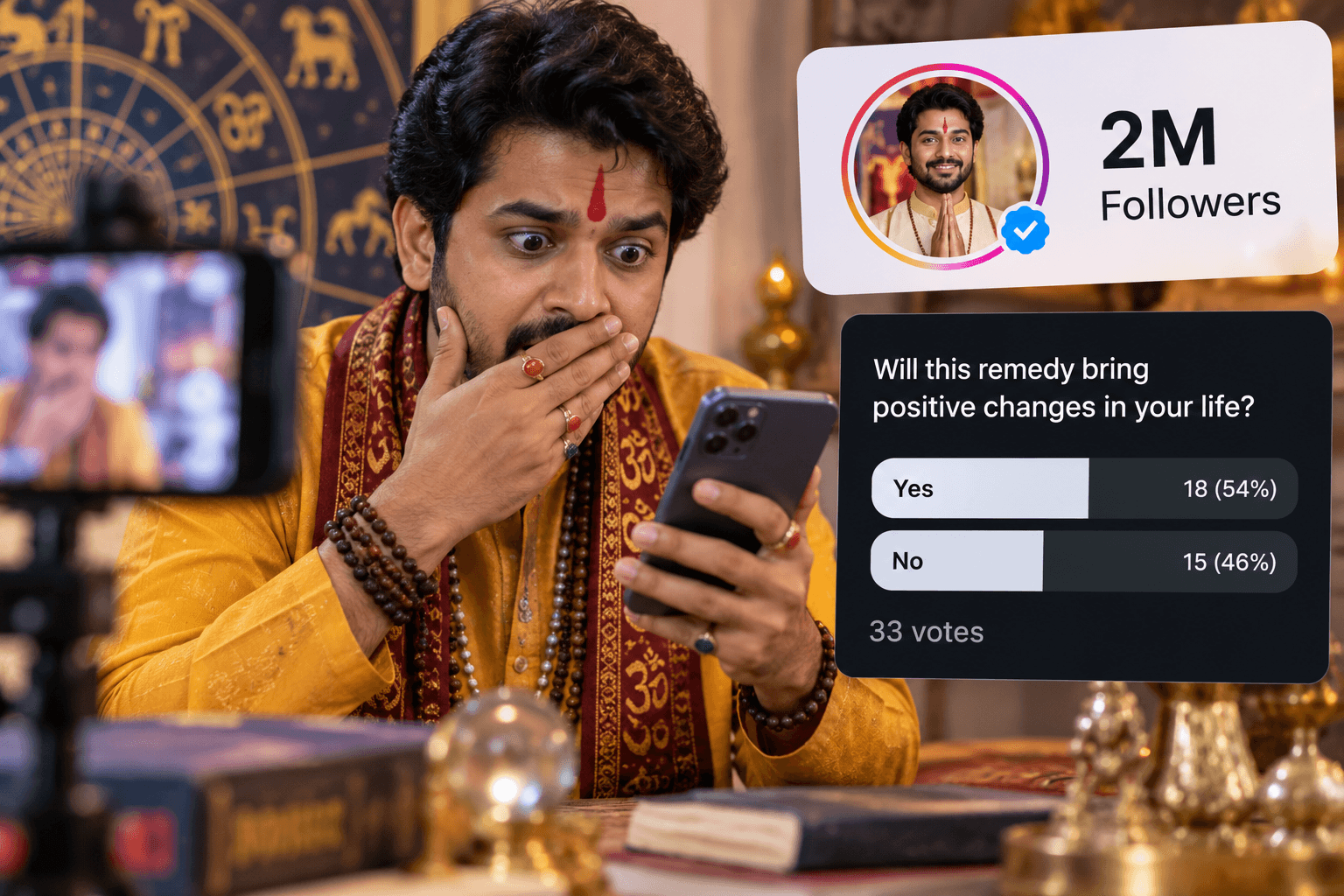
In a startling twist that has sent ripples through the world of digital influence, Omprakash Bishnoi—an astrologer with a following that exceeds two million across Instagram, Facebook and YouTube—lost the sarpanch election in the Jodhpur village of Indon Ki Dhani‑II by a margin that reduced his vote count to a mere 33 out of 1,600 eligible voters. The outcome underscores a growing disjunction between online popularity and grassroots political capital in rural India. Bishnoi, who also serves as the president of a local cow‑shelter, entered the race with the expectation that his celebrity status would translate into electoral success, a hypothesis that the ballot results have decisively refuted.
Key Context & Background
Astrology has long occupied a privileged niche in Rajasthan’s cultural fabric, where village elders and farmers routinely consult horoscopes before making agricultural and personal decisions. Bishnoi leveraged this tradition, building a digital persona that blended daily predictions with moral commentary, thereby amassing a following that dwarfs the population of many districts. Simultaneously, the state has witnessed a surge of social‑media‑savvy candidates attempting to convert follower counts into votes, a trend amplified by the proliferation of cheap smartphones and 4G connectivity in remote areas. However, the sarpanch election—governed by the Panchayati Raj system—remains rooted in localized networks of patronage, caste alliances and on‑the‑ground campaigning. Historically, candidates who command respect through tangible community service, such as water‑well projects or school initiatives, have outperformed those whose appeal is primarily virtual. Bishnoi’s role as president of a cow‑shelter, while socially commendable, did not align with the immediate material concerns—road repairs, electricity supply and agricultural subsidies—that dominate voter priorities in Indon Ki Dhani‑II.
Electoral Dynamics and Voter Sentiment
Field reports from the village indicate that the electorate’s skepticism stemmed from a perceived disconnect between Bishnoi’s digital persona and his on‑the‑ground accessibility. While his livestreams attract thousands, his physical presence in the hamlet is sporadic, leading many residents to view his influence as performative rather than substantive. Moreover, caste calculations—a decisive factor in Rajasthan’s village politics—placed Bishnoi at a disadvantage; his own community constitutes a minority in the constituency, limiting the mobilization of a reliable vote bank. Competing candidates, by contrast, deployed door‑to‑door canvassing, organized community feasts and promised concrete development projects, strategies that resonated more strongly with a voter base accustomed to tangible deliverables. The 33‑vote tally thus reflects not merely a failure of digital charisma, but a reaffirmation of entrenched sociopolitical structures that prioritize relational trust over virtual fame.
Broader Implications & Future Impact
Bishnoi’s defeat serves as a cautionary tale for a generation of influencers eyeing political office, suggesting that follower metrics are an unreliable proxy for electoral viability in India’s rural heartland. The episode may prompt political parties to recalibrate candidate selection criteria, emphasizing grassroots engagement and local credibility over social‑media reach. For the digital ecosystem, it highlights the limits of platform algorithms that reward engagement without accounting for the socioeconomic realities of a largely offline electorate. In the longer term, the mismatch could stimulate a new hybrid model of campaigning—where influencers partner with established local leaders to combine online visibility with on‑the‑ground legitimacy. Observers note that such a synthesis could redefine political communication in India, but only if it respects the nuanced fabric of caste, community service and material expectations that continue to dominate village-level decision‑making.