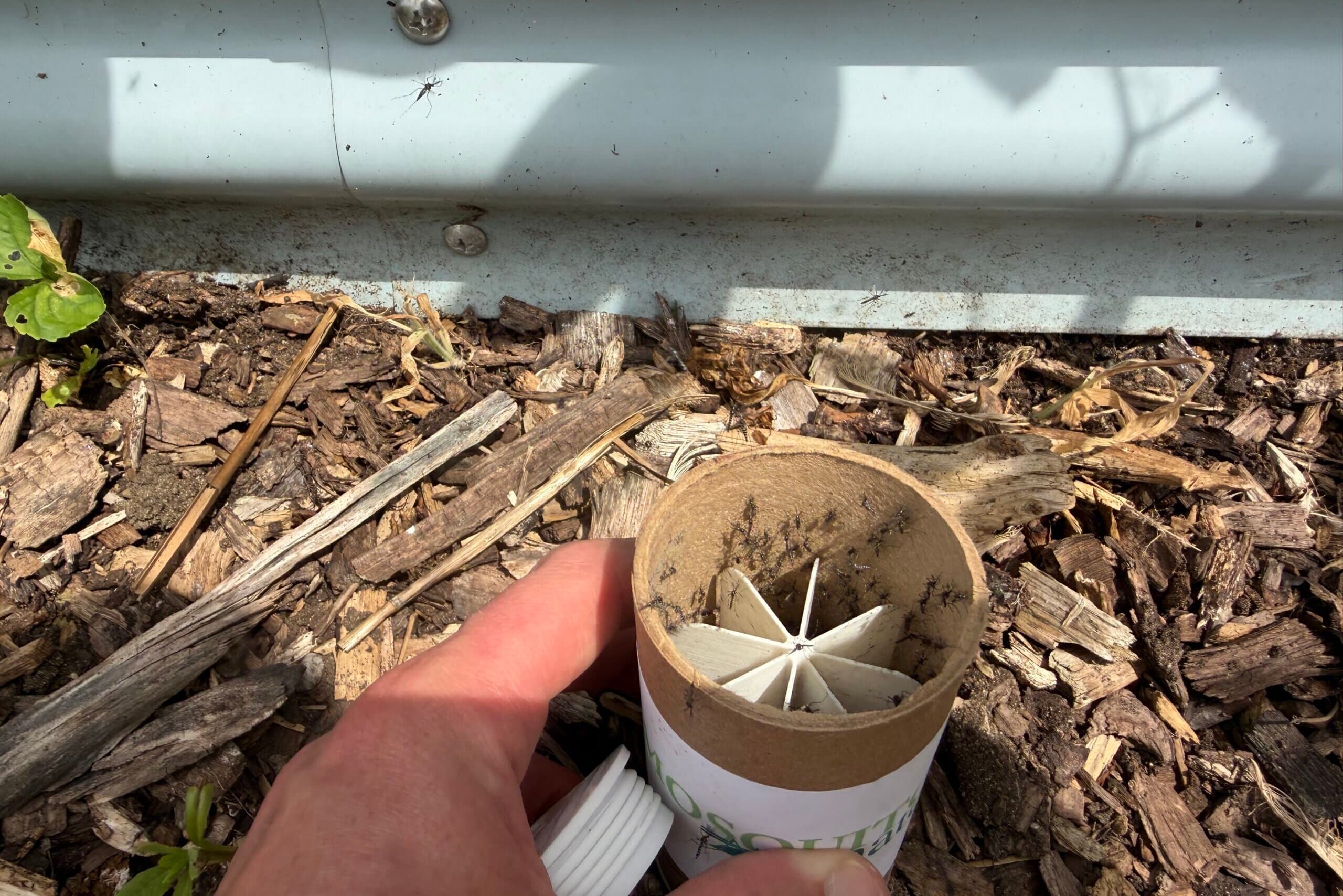
A private pest-control service, not a city program
It's worth being clear about who's behind this: the 600,000 mosquitoes being released across the greater Washington, D.C. area this summer are the work of Bee Safe Mosquito Control, a small business based in Silver Spring, Maryland — not a government or public health agency. Owner Todd Montgomery says his company is "the first in the DMV" (D.C., Maryland, Virginia) to offer a Wolbachia-release service commercially, targeting residential customers directly. The service costs roughly $1,000 per property, and the company — which serves around 25 residential customers across DC and Maryland — says it has already sold out for the 2026 season, with Montgomery hoping to expand next year. Releases began in early June and are scheduled to continue through September.
How it works
The mosquitoes, branded "ZAP males," are lab-reared Asian tiger mosquitoes (Aedes albopictus) infected with Wolbachia, a naturally occurring bacterium. Because only males are released, there's no added biting risk — male mosquitoes don't bite humans at all, regardless of infection status. When a Wolbachia-infected male mates with a wild, uninfected female, a phenomenon called cytoplasmic incompatibility means her eggs will not hatch; as Montgomery put it, "she's going around laying eggs that will never hatch," for the rest of her life. Bee Safe sources its mosquitoes from MosquitoMate, a Kentucky company built on technology developed at the University of Kentucky. It's worth noting this DC-area program specifically targets the Asian tiger mosquito, a different species from Aedes aegypti (the yellow fever mosquito), which is the target of a much larger, unrelated Wolbachia effort described below.
Why the Asian tiger mosquito specifically
The Asian tiger mosquito is a non-native, invasive, aggressive daytime biter and one of the most common mosquito species in the D.C. region. It's capable of transmitting a range of diseases, including dengue, Zika, yellow fever, eastern equine encephalitis, La Crosse encephalitis, and dog heartworm, according to the University of California, Riverside. As a non-native invasive species, removing it also carries a secondary ecological benefit beyond disease prevention, since it competes with native insect species for the same niche.
The track record elsewhere
This general approach has real, documented results in other parts of the world. Singapore's government has been releasing millions of Wolbachia-infected mosquitoes as part of a national program, aiming to cover 50% of households by the end of 2026, and has recorded reductions in treated-area mosquito populations of up to 90%. Citywide deployments have also produced steep drops in both dengue cases and mosquito counts in places including Niterói, Brazil, and parts of Colombia, according to the World Mosquito Program. Separately — and on a much larger scale than the DC effort — Google's parent company Alphabet, through its Debug program, has sought US regulatory approval to release tens of millions of Wolbachia-infected Aedes aegypti mosquitoes across California and Florida (estimates in different reports range from roughly 32 million to over 60 million), aimed at that different, disease-vector species rather than the Asian tiger mosquito targeted in the DC area.
The climate backdrop
The broader push behind Wolbachia-based mosquito control connects to a real and well-documented trend: rising temperatures are expanding the viable range of disease-carrying mosquito species, including both Aedes aegypti and Aedes albopictus, into parts of the continental United States where they were historically less established, raising longer-term concern about diseases like dengue gaining more of a foothold domestically. Public health researchers caution, however, that Wolbachia release is not a standalone solution — its effectiveness depends heavily on local ecology, consistent monitoring, and continued efforts to reduce standing-water breeding sites, alongside any release program.
Safety profile
Wolbachia is naturally present in a majority of insect species already, and the strain used in these programs is not associated with harm to humans, birds, fish, or other wildlife — its effect is specific to mosquito reproduction through cytoplasmic incompatibility, rather than acting as a broad-spectrum toxin. Because the approach targets a single invasive species' reproductive biology rather than killing insects indiscriminately (as broad insecticide spraying does), it's generally considered to have a narrower ecological footprint. Residents in treated neighbourhoods may notice more male mosquitoes visibly present, since the released males don't bite and are simply going about their reproductive purpose in the yard.