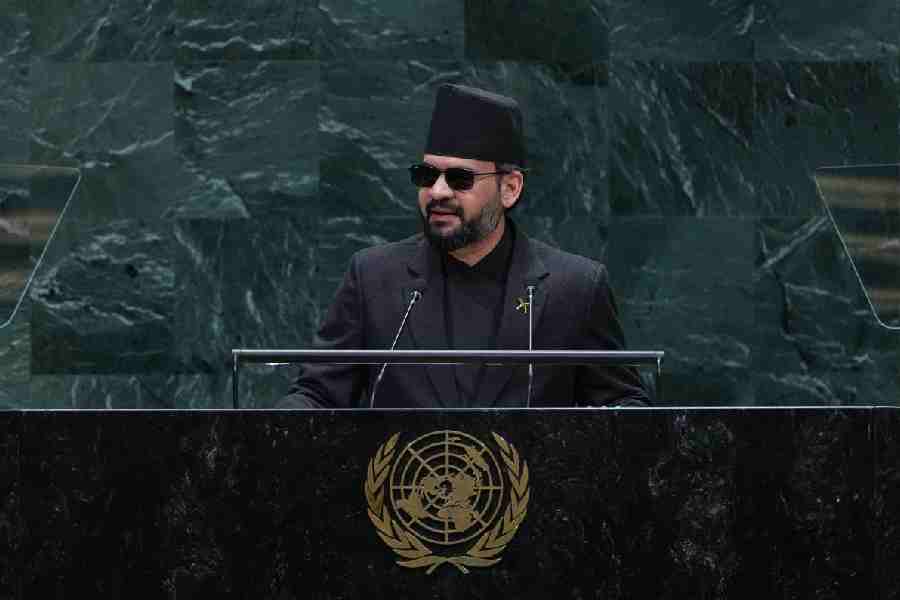
New York: Nepal's Prime Minister Balendra Shah used his address to the 81st session of the United Nations General Assembly to describe last month's devastating floods in Nepal's Himalayan region as a warning to the entire world. In the speech, delivered on Thursday, September 24 (New York time), he called for regional cooperation with India and China and grant-based climate support for vulnerable countries.
A Disaster Called the "Himalayan Tsunami"
The floods struck on August 26, when a glacial collapse and landslide sent torrents through communities along the Bhotekoshi and Trishuli river corridors. Shah told the Assembly that the disaster, which many have called a "Mountain Tsunami" or "Himalayan Tsunami," was not a local tragedy but a warning to the world. He said at least 1,400 people had died and more than 6,000 remained missing, and that recovery needs were estimated at about 10% of Nepal's GDP. Other counts reported in Nepali media differ slightly.
Shah said a warming climate was melting permafrost and destabilising Himalayan slopes, increasing the risk of ice-rock avalanches and floods. He noted that the disaster caused damage on both sides of the Nepal–China border and that the flood continued downstream into India, saying climate disasters do not respect borders. He thanked India and China for their prompt assistance.
A Proposal for India and China
As an "urgent first step," Shah proposed a Himalaya Climate Resilience Mechanism led by Nepal, India and China. The mechanism would involve sharing satellite data and expertise, monitoring dangerous glacial lakes, strengthening joint early warning systems, and coordinating assistance across borders when disasters strike. He said the Himalayas should become a laboratory of international cooperation rather than a frontier of fragmented information.
Climate Justice and Finance
Shah said Nepal contributes less than 0.1% of global greenhouse gas emissions but is paying a heavy price for a crisis it did not create. He argued that poor countries hit by climate disasters should not be forced to take on more loans to repair the damage, and called for adequate grant-based support, describing existing mechanisms such as the Loss and Damage Fund as grossly inadequate.
"Flawless Logistics for War"
Shah also questioned the priorities of the current global order. Describing shortages of fertiliser, bitumen and cooking gas in Nepal this year, he said weapons and ammunition cross borders on time while farmers in poor countries cannot get fertiliser or fuel when they need it. He said the world has built flawless logistics for war and broken logistics for food, and called for a fairer multilateral system in which small and vulnerable countries have a greater voice.
Sources
Full speech transcript published by Nepali Times and The Kathmandu Post; The Statesman; Nepal News; OnlineKhabar.
Latest Development
As of September 25, India and China have not publicly responded to the proposed Himalaya Climate Resilience Mechanism. Shah said Nepal would continue the discussion at a "Sagarmatha to Seaside" event at the UN.