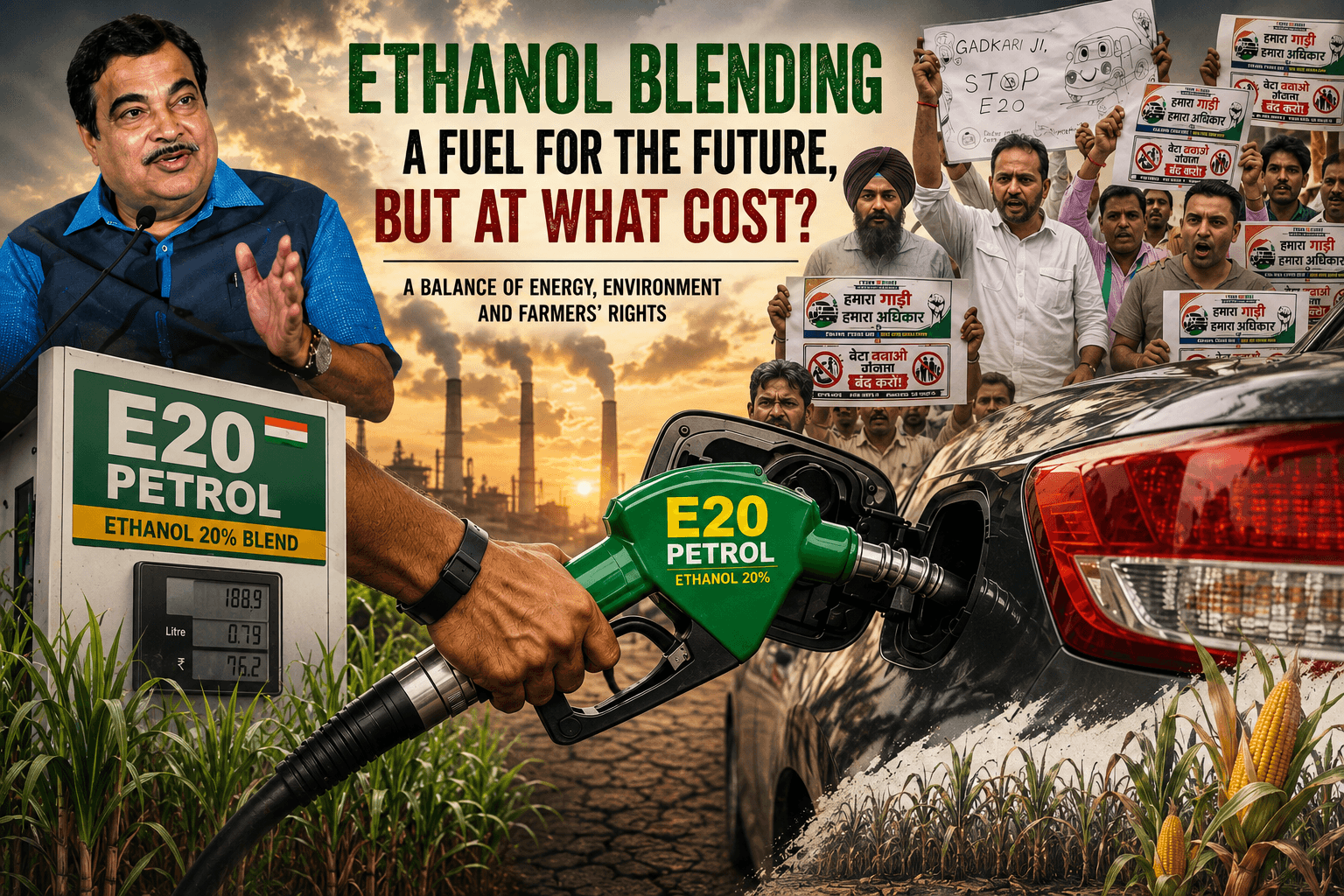
What happened at Jantar Mantar
On July 5, motorists gathered at Delhi's Jantar Mantar for what organisers called the first public protest against India's E20 ethanol-blended petrol mandate. The demonstration was led by TV personality and entrepreneur Tehseen Poonawalla through his advocacy group Team Bharat, under the slogan "Hamaari Gaadi, Hamaara Adhikaar" ("Our Vehicle, Our Right"). Organisers had projected turnout as high as 10,000, though actual attendance on the day was reported as modest — participants said they expected the movement to grow regardless.
Protesters carried signs reading "Our Vehicles, Our Rights" and "You promised development, not damage… Gadkari ji, stop E20," a direct reference to Union Road Transport Minister Nitin Gadkari, who has been closely associated with the ethanol push. Poonawalla was careful to clarify that protesters were not demanding an end to E20 fuel altogether, but rather that all blends — E0 (pure petrol), E5, E10, and E20 — be made available at the pump so consumers can choose.
The four core demands
Team Bharat's protest centered on four specific asks, repeated across banners and social media posts at the event:
- Availability of E0, E5, E10, and E20 fuels at petrol pumps, giving motorists a choice
- Public release of all documents related to E20, including the ARAI (Automotive Research Association of India) report
- A solution for owners of pre-2023 vehicles that protesters say have already sustained damage
- No further rollout of higher blends (such as E25) until nationwide infrastructure is fully ready
Why now: the "experiment" remark that lit the fuse
The protest didn't emerge in isolation — it followed weeks of escalating online anger that boiled over after a courtroom remark. Attorney General R. Venkataramani, speaking at a court hearing, was reported to have described the E20 rollout as an "experiment" whose results "would only come out next year." Video of the hearing went viral, and although Venkataramani later told Reuters he was referring specifically to ethanol supply volumes rather than the fuel-blending policy itself, the clarification did little to calm public anger. Critics, including Congress leader Priyank Kharge, argued the government "cannot challenge citizens to prove damage when your own data is still pending."
What motorists are complaining about
At the protest and in the weeks leading up to it, complaints clustered around three main issues:
Mileage loss
Numerous motorists, including an IT professional from Gurugram whose 2018 vehicle reportedly saw a sharp mileage drop, say fuel efficiency has declined noticeably since E20 became the default blend. Auto industry body ISMA has itself acknowledged tests showing mileage drops of up to 12% on older or less-optimised vehicles transitioning from E10 to E20.
Vehicle damage and repair costs
Several protesters described expensive repairs they attribute to ethanol exposure. One Delhi resident said a repair bill following E20-related issues crossed ₹35,000. Auto enthusiast Ratan Dhillon of Team Bharat said he intends to prove the damage in court, estimating fuel filter replacement costs on mid-range cars at ₹25,000–80,000, and noting that cold starts at high altitude (he cited a trip to Leh) are especially hard on ethanol-blended fuel.
Insurance uncertainty
A major flashpoint has been confusion over insurance coverage. ICICI Lombard, a leading private insurer, published guidance stating that using E20 fuel in vehicles certified only for E10 or lower "could be perceived as negligence," potentially leading to claim rejection for ethanol-related damage — and clarified that engine protection add-ons typically cover water ingress or oil leakage, not "chemical corrosion from fuel." This sparked significant alarm, since the vast majority of vehicles on Indian roads predate the April 2023 BS6 Phase 2 cutoff for E20 certification. The government has pushed back firmly: the Ministry of Petroleum and Natural Gas says using approved E20 fuel does not invalidate any motor insurance policy, and Petroleum Minister Hardeep Singh Puri has publicly rejected claims that insurers are denying payouts, saying "insurance companies have already clarified there is no such issue." Insurers themselves say the fuel type alone is never grounds for rejecting a claim — but consequential, gradual wear-and-tear damage (which ethanol-related corrosion could fall under) has never been covered by standard policies, fuel type aside.
The sugarcane farmer vs. distillery profit question
Protesters have also pointed to what they describe as an unfair profit split in the ethanol supply chain — alleging that sugarcane farmers receive only a few rupees per kilogram while distillery owners capture outsized margins once cane is converted to ethanol. The underlying numbers are genuinely contentious. The government's Fair and Remunerative Price (FRP) for sugarcane stands at ₹355 per quintal (₹3.55/kg) for the 2025–26 season — in the same range as protesters' cited figure — and farmer groups in cane-growing states have separately protested that even this amount is often reduced further by harvesting and transport deductions. On the distillery side, ethanol is sold to oil marketing companies at government-fixed prices that vary by feedstock (roughly ₹58–72 per litre depending on whether it's made from B-heavy molasses, C-heavy molasses, sugarcane syrup, maize, or rice), and industry data suggests per-litre profit margins for distilleries can range from roughly ₹3 to over ₹12 depending on feedstock and byproduct recovery. Sugar industry representatives, for their part, argue the opposite case — that ethanol prices haven't kept pace with rising FRP payouts to farmers, squeezing distillery margins rather than inflating them. Both sides of this pricing dispute have merit, and it remains one of the more technical, unresolved threads in the broader controversy.
The government's defense
The Centre has mounted a sustained pushback against the criticism. On July 2, the Ministry of Petroleum and Natural Gas issued a detailed note refuting claims that E20 reduces mileage, while Puri himself acknowledged some nuance, comparing ethanol's use in racing fuel: "They use it in racing cars also, the acceleration increases. Mileage, yes, it may drop a little." Separately, the ministry issued a "10-point clarification" addressing viral claims about engine damage, water usage in ethanol production, and insurance, stating that ARAI, Indian Oil Corporation, and other research bodies found no significant engine damage in compatible vehicles, and that ethanol production uses far less water than commonly claimed online.
Auto manufacturers have also weighed in publicly. Representatives from Maruti Suzuki, Toyota Kirloskar, Hero MotoCorp, TVS Motor, Bajaj Auto, and Hyundai Motor India held a joint press conference defending E20's safety, with Maruti stating its tests of E10-compatible vehicles on E20 fuel found no corrosion or wear issues, and Hero MotoCorp citing service data from millions of two-wheelers showing no elevated failure rates. Gadkari has separately challenged critics directly: "Show me one vehicle that has been damaged because of E20 petrol."
The government's press office has been blunter still, dismissing the backlash on social media as "wild claims" and urging the public not to "fall for the rage bait."
The bigger policy picture
India's Ethanol Blending Programme aims to cut crude oil import bills, reduce emissions, and boost farm incomes, and officially reached the 20% blending target by December 2025 — five years ahead of the original schedule. But the programme now faces a structural tension: installed ethanol production capacity has outpaced actual demand, with industry body ISMA noting that only about half of India's ~2,000 crore-litre annual capacity is being utilised at current E20 blending levels. That overcapacity is part of why some in the sugar and biofuel industry are pushing for even higher blends like E22 or E25 — a prospect that alarms the very motorists now protesting, since it would apply further pressure to engines not designed for high ethanol content. ARAI has reportedly been tasked with assessing the impact of E25 on E20- and E10-compliant vehicles, though no timeline for that transition has been finalised.
What's next
With Sunday's protest positioned as the first, not the last, in what organisers describe as a growing campaign, pressure is likely to continue building on two fronts: motorists demanding fuel choice and transparency, and the government defending a flagship energy and agriculture policy it considers non-negotiable. Attorney General Venkataramani's clarified position — that ethanol supply volumes, not the policy itself, remain under evaluation — suggests the Centre has no plans to reverse course, but the coming weeks will show whether public pressure forces concessions on fuel choice, insurance clarity, or a slower path to any future blend increase.