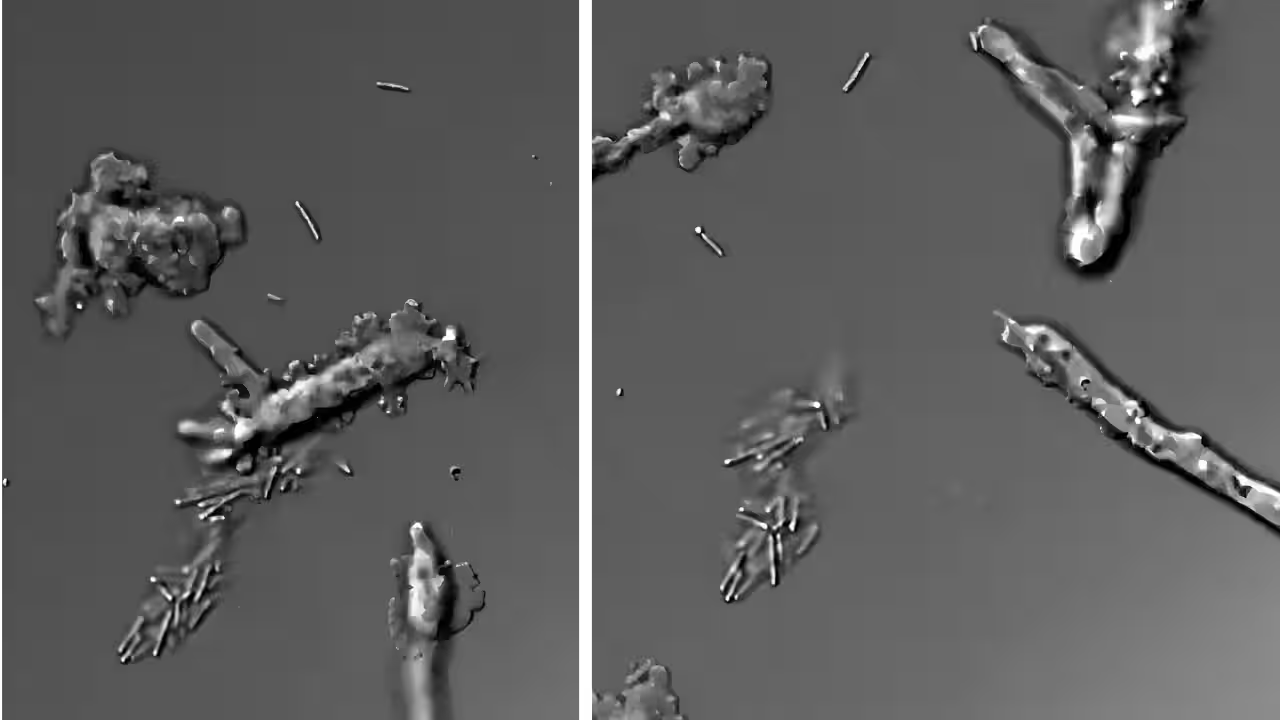
Scientists have discovered a single-celled amoeba that can reproduce at 63°C (145°F), the highest temperature ever recorded for a eukaryote, the group of organisms whose cells have a nucleus and membrane-bound organelles. The NASA-funded study, led by researchers at Syracuse University, has been published in the journal Cell.
What Was Found
The organism, named Incendiamoeba cascadensis and nicknamed the "fire amoeba," was found in the geothermal waters of Lassen Volcanic National Park in California. Its name translates roughly to "fire amoeba of the Cascade mountain range."
In lab tests, the amoeba fed and divided at 63°C and stayed active, moving around in search of food, at up to 64°C (147°F). The previous upper limit for eukaryotic reproduction was about 60°C (140°F), set by a few species of fungi and red algae. At 70°C (158°F), the amoeba formed a protective cyst and went dormant, later recovering. Researchers note that this dormant survival is not the same as growing and reproducing at that temperature.
Why It Matters
Bacteria and archaea, which lack a nucleus, have long been known to thrive far above 60°C. Eukaryotic cells were thought to be more vulnerable, because high heat can break down proteins and destabilise the delicate membranes around their internal structures. Some scientists had suggested that organelle membranes could not remain stable above about 62°C. The fire amoeba shows that assumption was wrong.
By sequencing the amoeba's genome and studying gene activity at different temperatures, the team found that heat switches on pathways linked to protein maintenance, DNA repair and membrane trafficking. Its proteins also carry surface features similar to those seen in heat-loving bacteria and archaea, suggesting that different branches of life arrived at similar solutions for surviving extreme heat.
Lead author Beryl Rappaport, a graduate student at Syracuse University, said assumptions about membrane stability may have limited research into heat-tolerant eukaryotes, and that the team hopes the discovery will encourage others to search for more. NASA and science outlets have noted the finding could widen the range of environments considered worth studying in the search for life beyond Earth.
Sources
NASA Science; Rappaport et al., "A geothermal amoeba sets a new upper temperature limit for eukaryotes," Cell (2026); NPR.
Latest Development
The peer-reviewed study was published this week in Cell, following an earlier preprint posted in November 2025. Researchers say the true maximum temperature a eukaryotic cell can survive remains unknown.