A correction worth making upfront
Reporting on how the FIR withdrawal demand was actually resolved points to a different, and arguably more significant, story than a private legal consultation: the commitment came directly from the government itself. At a joint press conference following a third round of talks, Union Health Minister JP Nadda and Minister of State Jitendra Singh, alongside CJP representatives Saurav Das and Ashutosh Ranka, announced the Centre had agreed to withdraw all police cases filed against protesting students nationwide, provide written confirmation of those withdrawals, and ensure compensation for families of students who died by suicide amid the paper leak controversy. No meeting with lawyer Kapil Sibal appears in current reporting on this story — worth double-checking against the original video's specific footage before publishing that detail.
'The first wicket': Dipke's message to supporters
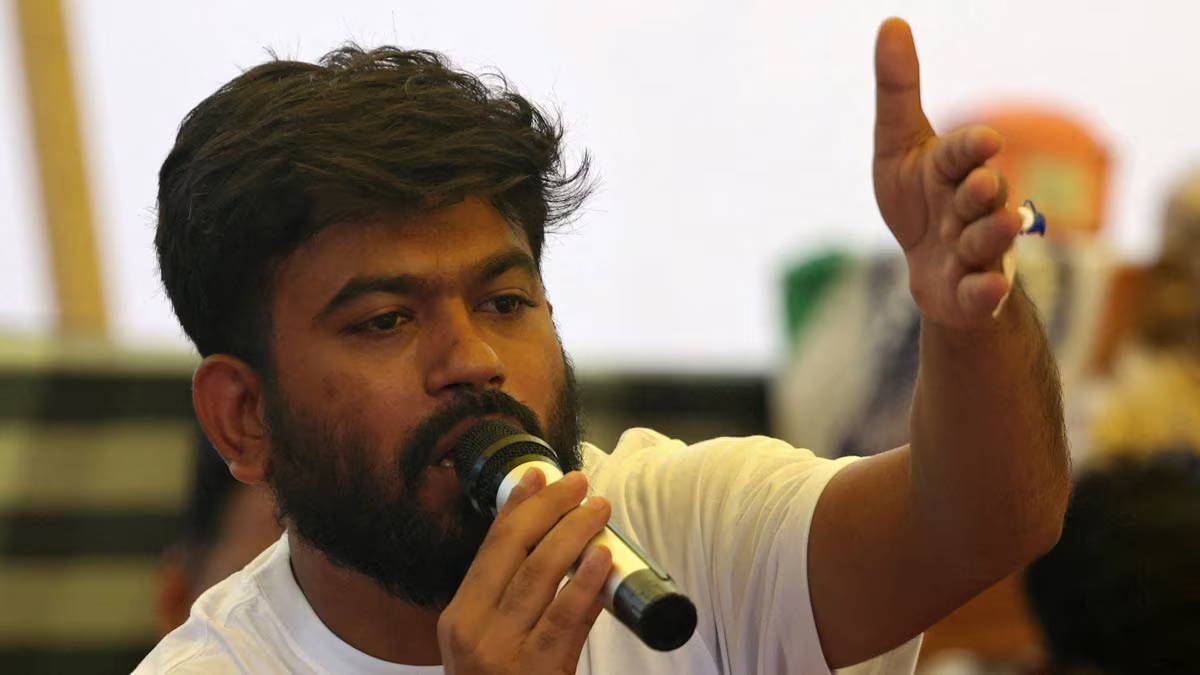
Addressing supporters at Jantar Mantar the day after Dharmendra Pradhan's resignation, CJP founder Abhijeet Dipke struck a tone of vindication rather than closure. "This resignation is proof that if you don't get scared and don't bend before this government, you can secure a resignation," he told the crowd, adding: "If you are scared to speak, how is it democracy? … They think they are kings because we sent them there." Calling Pradhan's exit "the first wicket," Dipke was explicit that the movement sees this as an opening result, not a finish line: "This is just the beginning." In a separate video message the following morning, he described the past 37 days as "really, really difficult" for his team, while striking a more personal, relieved note: "I could go to sleep and wake up in my bedroom without thinking about what to do next."
What CJP says comes next
Dipke has signalled that the movement intends to broaden beyond a single-issue campaign into a sustained push on education reform, with an eye toward organising in states including Uttar Pradesh and Bihar. He has described CJP's ambitions in terms of building a genuine "political youth movement" rather than a protest vehicle tied to one grievance — a framing consistent with the group's own account of its origins, which began as satire in response to a Chief Justice's remark comparing unemployed youth to "cockroaches" before evolving into one of the largest youth-led agitations in recent memory.
The team behind the movement
Two figures have been consistently identified in official statements as CJP's chief public representatives alongside founder Abhijeet Dipke: Saurav Das, described as CJP's chief spokesperson, and Ashutosh Ranka, its national spokesperson — both of whom represented the movement directly in negotiations with Nadda and Jitendra Singh. Reporting reviewed for this article did not independently confirm a fourth core leader matching the description of a JNU student named Neha Bora; if the original source video names her specifically, it's worth verifying that detail against a primary CJP statement before publishing, since she was not identified in the wire coverage of the movement's negotiating team.
The ground reality: Jantar Mantar restored, Delhi Metro fully reopened
Saurav Das said CJP was withdrawing its agitation "in good faith," with the understanding that the government's commitments would be implemented within the agreed timelines. Following the withdrawal, the New Delhi Municipal Council (NDMC) worked through the night to restore the protest site: clearing garbage, washing roads, and repainting walls. "After the protest ended yesterday and people began leaving, our entire NDMC team worked through the night," NDMC Vice Chairman Kuljeet Singh Chahal said, describing the operation as deploying "all our resources." The Delhi Metro Rail Corporation, which had closed multiple central Delhi stations amid the protest and related security measures, reopened all entry and exit gates across its network once the agitation ended, restoring normal commuter service to the area. Internet services in central Delhi, which had reportedly been restricted during the tensest phase of the protest, were also restored.
A note on the hunger strike's duration
Activist Sonam Wangchuk's hunger strike, which became a central rallying point for the movement, ran 26 days — distinct from the 37-day length cited for the broader Jantar Mantar agitation as a whole. The two figures describe different things and shouldn't be used interchangeably.