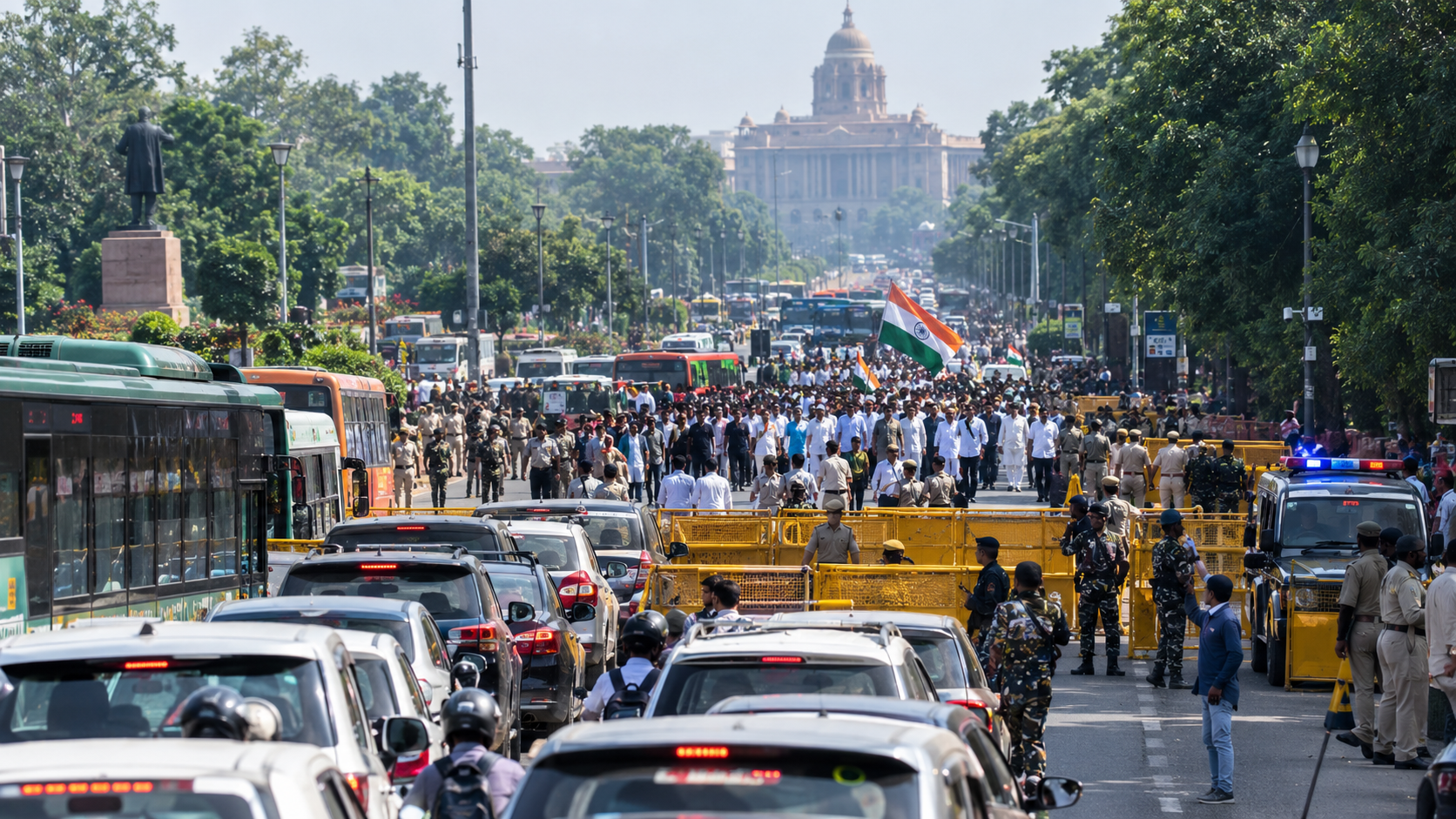
Commuters in central Delhi have been warned to stay clear of Jantar Mantar, Parliament Street, Ashoka Road and surrounding lanes as the INDIA bloc stages a massive march toward the Election Commission. The protest, sparked by a lingering dispute over the Service‑in‑Revenue (SIR) rule, has prompted the municipal authorities to impose diversions, barricades and temporary traffic bans. Officials estimate that the disruption could affect up to 200,000 daily commuters, underscoring how a procedural row has quickly morphed into a city‑wide logistical challenge.
Key Context & Background
The SIR rule, introduced in 2022 to streamline the allocation of service‑related revenue between the central and state governments, has long been a flashpoint for regional parties that argue it erodes fiscal autonomy. The INDIA coalition—an alliance of opposition parties formed after the 2024 general election—has accused the ruling party of manipulating the rule to siphon funds from state coffers, especially in revenue‑rich states like Delhi. The dispute intensified after the Election Commission’s recent clarification, which the bloc claims is a “technical loophole” that still disadvantages opposition‑run administrations. Historically, Delhi’s unique status as a Union Territory with an elected assembly has made it a battleground for centre‑state power struggles, and the SIR controversy is the latest episode in a series of fiscal tussles dating back to the 1990s.
On‑Ground Disruptions
The protest route cuts through some of Delhi’s most congested arteries, forcing the Delhi Traffic Police to erect steel barricades and reroute buses, auto‑rickshaws and private vehicles. Real‑time traffic apps report a 45‑percent increase in travel time across the affected stretch, with peak‑hour commuters facing delays of up to an hour. Schools and government offices in the vicinity have issued advisories, and several private firms have allowed flexible working hours to mitigate the impact. While the authorities have promised rapid clearance once the march concludes, the sheer scale of the demonstration—estimated at 15,000 participants—means that normal traffic flow may not resume for several days.
Broader Implications & Future Impact
Beyond the immediate inconvenience, the march signals a deepening politicisation of fiscal policy in India’s federal framework. If the INDIA bloc succeeds in compelling the Election Commission to revisit the SIR rule, it could set a precedent for other states to demand similar concessions, potentially reshaping the balance of revenue sharing. Moreover, the episode highlights how infrastructure and public services can become leverage points in political negotiations, a trend that may encourage future protests to target high‑visibility urban corridors. For investors and businesses, the episode serves as a reminder that policy volatility in key metropolitan hubs can translate into operational risk, prompting firms to reassess supply‑chain resilience and contingency planning in the capital region.
Political Calculus Ahead
Analysts view the march as a strategic move by the opposition to keep fiscal grievances in the public eye ahead of the 2029 state elections. By staging a high‑profile demonstration in the heart of the nation’s political arena, the INDIA bloc aims to pressure the central government into a negotiated settlement before the next electoral cycle. The ruling party, meanwhile, is walking a tightrope: a heavy‑handed response could be portrayed as suppressing democratic dissent, while a conciliatory stance might embolden further challenges to its fiscal agenda. The unfolding drama will likely influence how future centre‑state disputes are managed, with Delhi’s traffic snarls serving as a vivid, if unintended, barometer of political tension.