The Commons Voice Wire|Independent Journalism & Public Record
Live FX:USD/INR--•EUR/USD--•GBP/USD--
Contact Desk|Edition: Global
↵
The Commons VoiceThe Independent International Journal of Record & Critical Inquiry
Sign InSubscribe£2/wk
HomeGeneralPoliticsScience & TechBusinessWorld
HomeGeneralPoliticsScience & TechBusinessWorldSportsDefence
Contact Us|Section Index→

The Commons Voice

Independent International Broadsheet of Record

Dedicated to verified reporting, geopolitical perspective, and rigorous editorial analysis across continents and cultures. Published without corporate or partisan bias.

Newsroom & Editorial Desk

For news tips, corrections, press releases, and editorial submissions:

contact@thecommonsvoice.comContact Page→
Editorial Sections
  • General News & Wire
  • Politics & Statecraft
  • Science & Technology
  • Sports & Entertainment
  • Business & Commerce
  • World & Regional Wire
  • Defence & Strategic Affairs
Investigative Units
  • Climate Observatory
  • Financial Forensic Desk
  • Elections & Polling Tracker
  • Commons Podcast Network
  • Special Documentary Archive
Commons Trust
  • Contact Us & Desk
  • Editorial Code of Ethics
  • Corrections & Clarifications
  • Press Freedom Charter
  • Subscriber Help Desk
Newsroom Desk
  • Official Email: contact@thecommonsvoice.com
  • Office: Dehradun, Uttarakhand, India
  • Response: Within 24–48 Hours
  • Open Contact Us Form→

© 2026 The Commons Voice. Independent journalism for the global public interest.

Contact Us•About Us•Privacy Policy•Terms of Service
Home/Articles/Science & Technology
Science & Technology

125 Years Ago Today, J.C. Bose Filed a Landmark US Patent That Helped Pave the Way for Semiconductors

A
By Admin
September 30, 2026
📖3 min read
125 Years Ago Today, J.C. Bose Filed a Landmark US Patent That Helped Pave the Way for Semiconductors

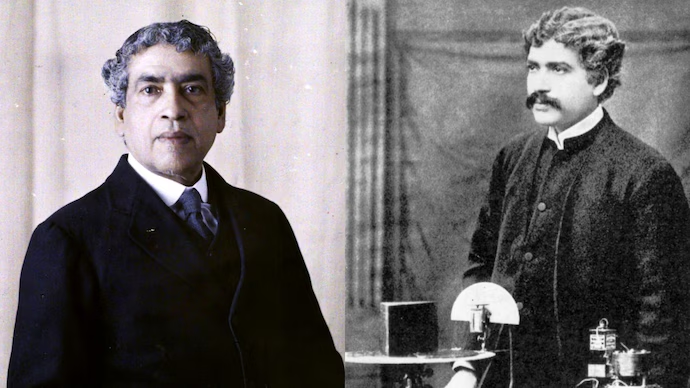
On September 30, 1901, exactly 125 years ago, Indian physicist Jagadish Chandra Bose filed a patent application in the United States for a "Detector for Electrical Disturbances." Granted on March 29, 1904, as US Patent No. 755,840, it is widely described as the first US patent awarded to an Indian, and it covered one of the earliest semiconductor devices ever made.

What Bose Invented

Bose, then a professor of physics at Presidency College in Calcutta, had been studying radio waves at very short wavelengths. His patent described a detector for "electrical disturbances, Hertzian waves, light-waves, and other radiations" that used galena, a crystal of lead sulphide, as its sensitive material. By touching the crystal with a fine metal point, the device could detect incoming radio signals.

The Computer History Museum in California describes the patent as covering a point-contact semiconductor rectifier for detecting radio signals, a forerunner of the "cat's whisker" crystal detectors that powered early radio sets before vacuum tubes took over.

The Reluctant Patent-Holder

Bose was famously opposed to patenting scientific discoveries, believing knowledge should be freely available. He filed the application only after being persuaded by his American friend Sara Chapman Bull, who was assigned a half share in the patent. Years later, when he founded the Bose Institute in Kolkata in 1917, he reportedly ensured its founding documents barred members from seeking patents.

A Legacy Still Being Recognised

Beyond his detector, Bose built millimetre-wave transmitters, waveguides and horn antennas, designs that remain in use in modern forms today. He later turned to plant physiology, pioneering instruments that measured how plants respond to stimuli. Historians and engineers increasingly regard him as one of the founding figures of radio science.

Sources

US Patent 755,840 (via Wikisource); Computer History Museum; IEEE India Council; EDN.

#jagadish chandra bose#j.c. bose#semiconductors#radio#indian science#history#patents
← Previous ArticleINDIA Bloc Meets in Delhi Over SIR Row, Weighs Motion to Remove CEC Gyanesh Kumar; AAP, DMK Stay AwayNext Article →Robot Finger Covered in Living Human Skin: The Japanese Experiment Going Viral Again

Comments

Loading...
Log in to comment