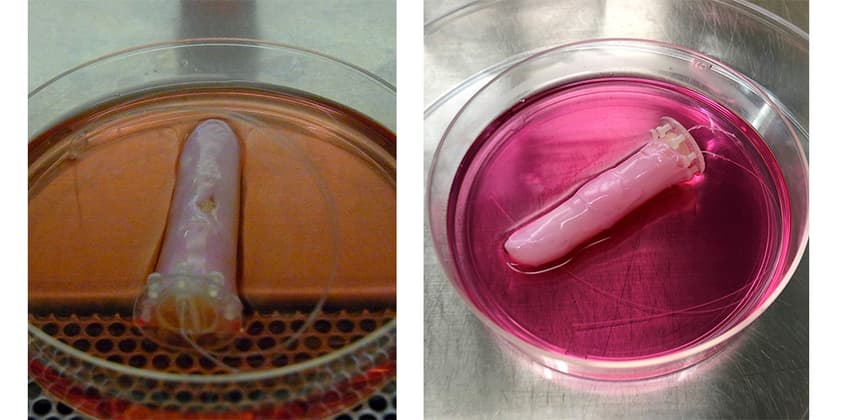
A robotic finger covered in living human skin, built by researchers at the University of Tokyo, is doing the rounds on social media again. The experiment, first published in the journal Matter in June 2022, remains one of the most striking examples of "biohybrid" robotics, which combines living tissue with machines.
How the Skin Was Made
The team, led by biohybrid engineer Shoji Takeuchi, immersed a three-jointed robotic finger in a mixture of collagen and human dermal fibroblasts, the cells that form the skin's inner dermis layer. They then applied human keratinocytes to create an outer epidermis. Growing the skin directly on the finger, rather than wrapping it in a flat sheet, meant it fit perfectly and could bend without tearing. The finished skin was about 1.5 millimetres thick and was anchored to the robot by small mushroom-shaped fasteners.
What It Could Do
As the finger moved, the skin stretched with it and formed natural-looking wrinkles at the knuckles. When the researchers cut the skin and covered the wound with a collagen sheet, the skin's cells merged the patch into the surrounding tissue, repairing the damage within about a week. "We have created a working robotic finger that articulates just as ours does, and is covered by a kind of artificial skin that can heal itself," Takeuchi said at the time.
The Limits
The skin is still a laboratory prototype. Because it has no blood vessels, it depends on a nutrient bath and moisture to stay alive, and reports at the time said it could survive only about an hour outside its culture medium. The team said future work would focus on adding circulatory systems, as well as nerves and sensory receptors, and on covering larger robotic structures.
Why It Matters
Researchers see potential uses in more realistic prosthetics, testing of cosmetics and medicines, and future humanoid robots designed to work closely with people in healthcare and service roles, where a soft, human-like touch could be an advantage.
Sources
Kawai M., Nie M., Oda H., Morimoto Y., Takeuchi S., "Living skin on a robot," Matter (2022), doi:10.1016/j.matt.2022.05.019; University of Tokyo; ABC News (Australia); SoraNews24.