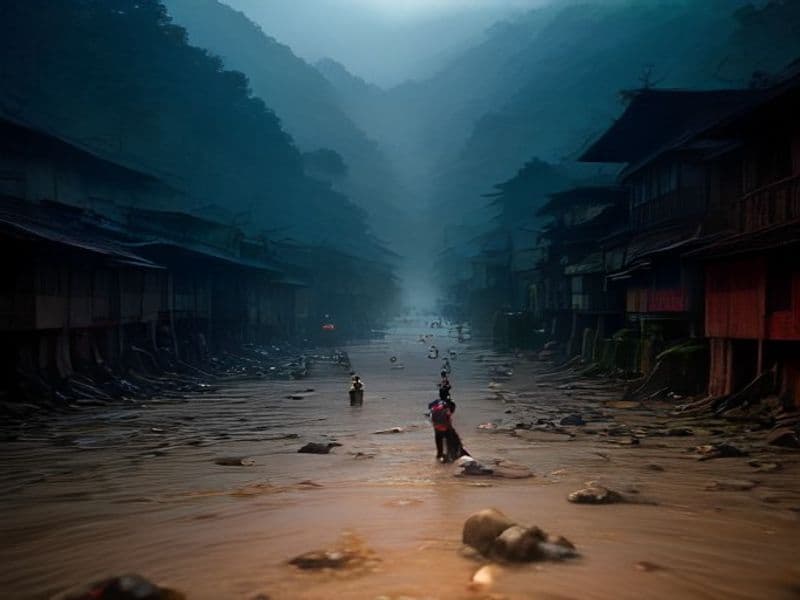
A sudden deluge swept through Nepal’s western districts on Saturday, leaving at least 160 people dead and a staggering 844 still missing, according to official tallies. The disaster, triggered by a massive flash flood in the Karnali basin, has rippled across the border, with Chinese authorities reporting three deaths and 265 missing in Tibet’s Gyirong county. Among the untraced are 466 foreigners from 28 nations and 113 Nepalis, including a minimum of 133 Indian nationals, underscoring the trans‑national scale of the tragedy.
Key Context & Background
The flood was precipitated by an unprecedented cloudburst that saturated the upper reaches of the Karnali River, a tributary already strained by rapid glacial melt. Over the past decade, the Himalayas have recorded a 30 % rise in extreme precipitation events, a pattern climate scientists link to warming temperatures and altered monsoon dynamics. In addition, the region’s topography—steep valleys, poorly anchored riverbanks, and a legacy of unregulated construction—amplifies the destructive potential of sudden water surges. Historical records show that similar flash floods have struck the area in 2013 and 2018, each time exposing gaps in early‑warning systems and cross‑border coordination.
Humanitarian Response & Coordination
Rescue operations have unfolded on three fronts: Nepal’s army and police, Chinese border patrols, and a coalition of NGOs from India, the United Kingdom, and Australia. The sheer scale of the disaster—33 bodies recovered 150 km downstream in Chitwan—has forced authorities to deploy helicopter units, flood‑resistant boats, and mobile medical camps. Yet logistical bottlenecks persist, especially in remote villages where roads are washed away. The involvement of Indian nationals has prompted New Delhi to dispatch a dedicated disaster‑relief team, while diplomatic channels are being used to share satellite imagery and river‑flow data with Beijing, marking one of the few instances of real‑time cooperation between the two neighbors on a natural‑hazard response.
Broader Implications & Future Impact
The calamity highlights a convergence of climate risk, infrastructure fragility, and geopolitical complexity. For Nepal, a country heavily reliant on tourism and hydropower, the loss of lives and displacement of thousands threatens economic recovery already hampered by the COVID‑19 pandemic. The flood also raises urgent questions about the sustainability of unregulated hydropower projects that line the riverbanks, many of which have been criticized for inadequate environmental assessments. Regionally, the event may accelerate calls for a formalized Himalayan early‑warning network, a proposal championed by the United Nations Development Programme but stalled by divergent national priorities.
Policy Lessons & Recommendations
Experts argue that the tragedy should catalyze a multi‑layered strategy: first, expanding real‑time meteorological monitoring across the trans‑border river basins; second, enforcing stricter building codes for settlements and hydropower installations in flood‑prone zones; and third, institutionalizing a joint Nepal‑China‑India task force for disaster mitigation. Investment in community‑based evacuation drills and the construction of flood‑plain retention basins could reduce future casualties. As climate projections suggest an increase in extreme weather events across the Himalayas, the current response may serve as a pivotal benchmark for how South Asia adapts to a new era of climate‑driven hazards.