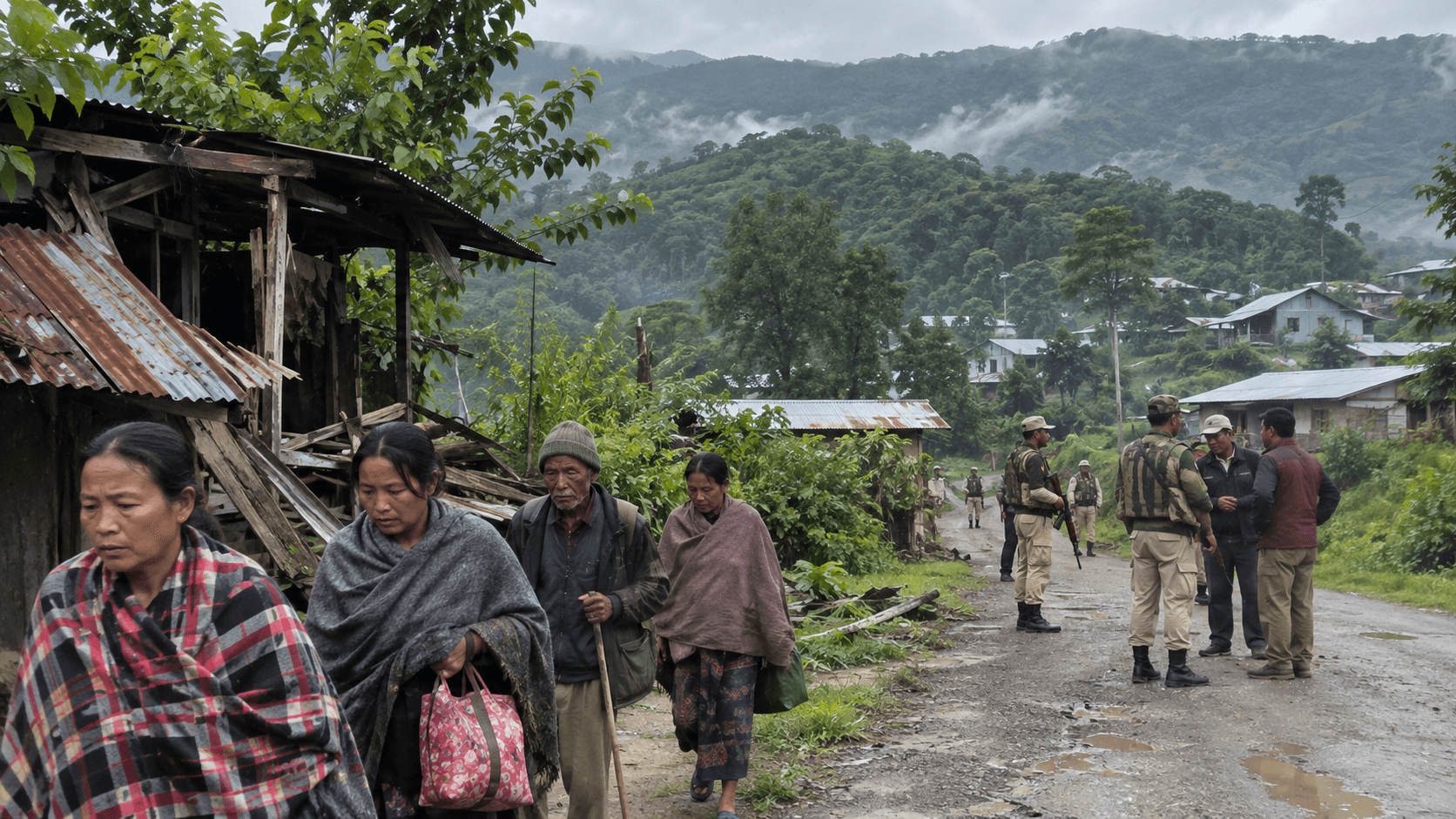
Three armed cadres of Zeliangrong insurgent groups were killed in a violent confrontation in Manipur’s Noney district on Tuesday, marking the latest flashpoint in a fragile peace that has been under strain since the state’s 2023 ethnic clashes. The firefight erupted after one faction accused the other of collaborating with the Indian security apparatus, prompting an exchange of gunfire that spilled into nearby villages and even reached passenger vehicles in Ukhrul, though no civilians were injured. The incident has prompted the Manipur government to accelerate the formation of local peace committees, a move aimed at preventing further escalation among the myriad armed outfits that operate in the region.
Key Context & Background
The Zeliangrong community, straddling the borderlands of Manipur, Assam and Nagaland, has long been a hotbed of insurgency, driven by grievances over land alienation, political marginalisation, and perceived neglect by successive state governments. Two principal armed outfits— the Zeliangrong Liberation Front (ZLF) and the Zeliangrong People's Front (ZPF)— have historically competed for recruitment, resources and legitimacy. The rivalry intensified after the 2023 ethnic violence that pitted Meitei and Kuki groups against each other, creating a security vacuum that both ZLF and ZPF sought to fill. Recent intelligence reports suggest that the state’s security forces have pursued a “divide and rule” strategy, offering limited concessions to one group in exchange for intelligence on the other, a tactic that has sown distrust and provoked accusations of betrayal within the insurgent milieu.
Broader Implications & Future Impact
The Noney gunfight underscores the precarious balance between state‑led counter‑insurgency and the risk of fragmenting rebel coalitions into even more volatile splinter groups. If the perception that certain factions are cooperating with security forces spreads, it could trigger a cascade of retaliatory attacks, jeopardising the tentative ceasefire that has held in many parts of the state since late 2023. Moreover, the spillover of violence into civilian transport corridors, as witnessed in Ukhrul, threatens to erode public confidence in the government’s ability to safeguard everyday life, potentially fueling support for armed actors who promise protection. Economically, the persistent insecurity hampers investment in the region’s nascent tourism and agro‑processing sectors, reinforcing a cycle of underdevelopment that insurgents routinely exploit for recruitment.
Local Response & Peace Initiatives
In response to the latest bloodshed, the Manipur administration has fast‑tracked the creation of district‑level peace committees, drawing on community elders, civil‑society representatives and former combatants to mediate disputes. While the model mirrors successful conflict‑resolution frameworks employed in the northeast during the early 2000s, its efficacy hinges on genuine power‑sharing and the inclusion of all Zeliangrong factions, including those that have historically shunned dialogue. Critics argue that the government’s rapid rollout may be more symbolic than substantive, pointing to a lack of clear mechanisms for disarmament verification and compensation for victims. Nonetheless, the committees could serve as a conduit for de‑escalation, provided they secure the trust of grassroots actors and are insulated from political interference.