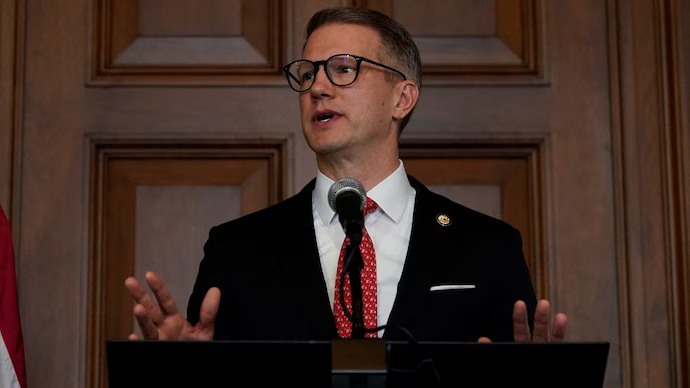
A US congressman weighs in
US Congressman Riley Moore has waded into India's domestic legislative debate over the Foreign Contribution (Regulation) Amendment Bill, 2026, calling it "a clear attack against Christians" in a post on X that traced Christianity's roots in India back to St. Thomas the Apostle's arrival on the Malabar Coast. "Despite this long Christian history, India's Parliament is considering amending Foreign Contribution Regulation Amendment (FCRA) rules to permit government takeovers of churches and religious charities," Moore wrote, warning that if the bill proceeds as currently framed, "it would be a point of major concern in our bilateral relationship with India." The remarks have added an international dimension to what was already a live domestic controversy, with the bill remaining a flashpoint during Parliament's Monsoon Session.
A correction on the funding threshold
One figure requires correction: the bill's new renewal threshold is not ₹1 lakh but ₹10 lakh. Under the proposed rules, organisations that utilised less than ₹10 lakh in foreign contributions across the previous two financial years would become ineligible to renew their FCRA registration — a tenfold difference from the ₹1 lakh figure sometimes cited, and one that meaningfully changes how many smaller organisations the provision would actually affect.
What the bill actually does
Introduced in the Lok Sabha on March 25 by Minister of State for Home Nityanand Rai, the bill's most significant structural change is the creation of a government-appointed Designated Authority empowered to take over supervision, management, and disposal of an organisation's foreign contributions and any property acquired using them, once that organisation's FCRA certificate is cancelled, voluntarily surrendered, or allowed to lapse without renewal. Notably, for assets that are places of worship specifically, the bill requires the Authority to "ensure that its religious character is maintained" — a built-in safeguard that complicates the framing of the bill as enabling straightforward "takeovers" of churches, even as critics argue the broader transfer of control to a government-appointed body remains the core concern regardless of that safeguard. The bill also tightens rules on transferring foreign funds between entities and requires greater transparency around project activity and social media presence, while introducing one change that cuts in the opposite direction of a "crackdown" narrative: it actually reduces the maximum prison sentence for violations of the Act from five years to one year.
The numbers behind the debate
According to figures shared alongside the bill, 13,520 organisations received a combined ₹55,741 crore in foreign contributions between 2019 and 2022. As of July 15, 2026, there were 14,449 active FCRA certificates nationwide, alongside 22,498 that have been cancelled over time and a further 15,212 that have simply expired — the pool of organisations whose assets could potentially come under the new Designated Authority's purview.
Where the government stands
Introducing the bill, Rai said its objective was to make the use of foreign contributions "more transparent and accountable," and warned that any activity working against "the spirit of the Constitution, laws and the national interest" would not be tolerated — while stressing that institutions whose objectives align with India's sovereignty and integrity "will not be obstructed." Union Minister Kiren Rijiju has since taken the government's case directly to affected communities, telling stakeholders during a visit to Kerala that "misunderstandings" about the bill would be addressed and that concerns raised specifically by Christian missionary organisations would be taken into account, while accusing opposition parties of "spreading misinformation for political gain."
Where critics stand
Opposition parties and a range of NGOs — not limited to religious organisations — have argued the bill hands the government excessive discretionary power over assets like schools, hospitals, and places of worship run by social and religious bodies, particularly through the Designated Authority mechanism. This isn't the first time FCRA amendments have drawn this kind of criticism: a previous round of changes drew similar warnings from opposition MPs that provisions could be used to target NGOs working on Dalit and minority issues, or create obstacles for Christian missionary-run schools, with the government responding then, as now, that the law is religion-neutral and aimed solely at curbing misuse of foreign funds.