Amarnath Yatra 2026 Begins: 57-Day Pilgrimage Kicks Off Under Tight Security Amid Registration Rush
A
By Admin📖5 min read
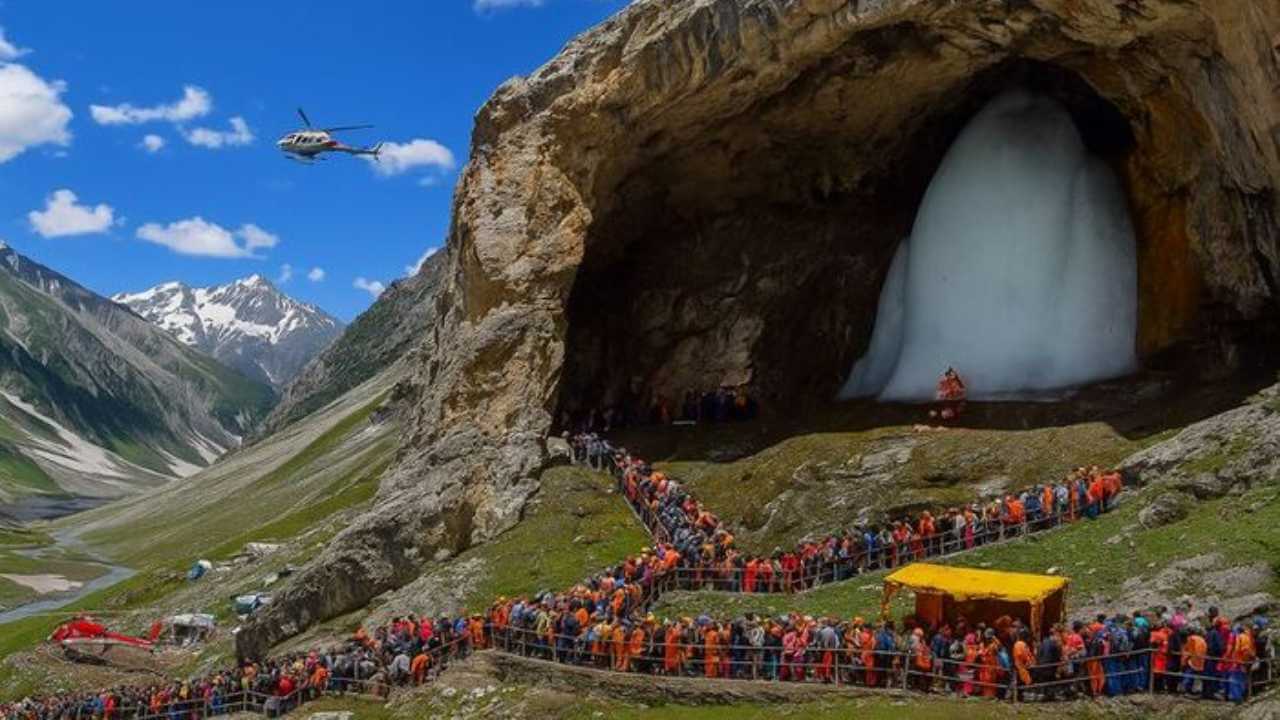
The annual Shri Amarnath Ji Yatra formally began on July 3, marking the start of a 57-day pilgrimage to the holy cave shrine of Lord Shiva in the Kashmir Himalayas, with the first batches of devotees setting off from the twin base camps at Baltal and Pahalgam under heavy security.
The routes
Pilgrims can choose between two officially approved paths to the cave, situated at roughly 3,880 metres. The Baltal route is the shorter option at about 14 km, steep but doable in a single day, allowing pilgrims to complete darshan and return without an overnight stay. The traditional Pahalgam route is considerably longer, at roughly 46–48 km, and typically takes three to four days, with pilgrims halting overnight at Sheshnag and Panjtarni before reaching the cave — meaning many who set out this week are expected to complete their darshan around July 4–5, depending on their exact start date.
The send-off
Lieutenant Governor Manoj Sinha, who chairs the Shri Amarnathji Shrine Board (SASB), flagged off the first convoy from the Bhagwati Nagar Yatri Niwas base camp in Jammu in the early hours, offering prayers before the pilgrims departed. More than 4,800 pilgrims travelled in secured convoys on the opening day, with roughly 2,510 reaching the Pahalgam (Nunwan) base camp and 2,312 reaching Baltal, where they were welcomed by J&K Minister Satish Sharma and senior police and administrative officials. Union Home Minister Amit Shah and Chief Minister Omar Abdullah's administration both extended greetings, with Shah highlighting the "multi-layer security grid" and QR-code-based registration system put in place for this year's yatra. Prime Minister Narendra Modi also wrote to pilgrims ahead of the yatra, calling the pilgrimage a "great privilege" and urging devotees to observe "five sankalps" (resolutions) during the journey.
At both base camps, the mood was one of pure devotion — chants of "Har Har Mahadev," "Om Namah Shivaya," and "Bam Bam Bhole" echoed through the crowds as pilgrims, including sadhus from across the country, prepared to begin their trek.
Security on the ground
This year's yatra is being conducted under what officials have called an unprecedented, multi-layered security cover, with the Indian Army, CRPF, BSF, J&K Police, and other central armed police forces deployed along both routes. A specialised CRPF sanitisation sweep, including K9 units, was carried out along the Jammu-Srinagar National Highway before convoys began moving, and authorities have set up round-the-clock police deployment, dedicated "Helping Hand" teams, and assistance booths along the route. RFID tracking cards are mandatory for every registered pilgrim and are required to pass through the access-control gates at Domail (Baltal) and Chandanwari (Pahalgam).
Registration crunch in Jammu
With around four lakh (400,000) pilgrims having pre-registered and more arriving daily, Jammu has seen a heavy crush of devotees hoping to secure on-the-spot ("Tatkal") registration. The district administration has set up 18 registration and token counters across the city — including at the Tawi Riverfront, Geeta Bhawan, Ram Mandir (Purani Mandi), Bhagwati Nagar, and the railway station — issuing a limited number of tokens each morning on a first-come, first-served basis. Authorities have been explicit that on-spot slots are limited and cannot accommodate every unregistered pilgrim who arrives, urging devotees to travel only on their allotted registration date and to be patient while waiting their turn. Long queues and pilgrims camping out near registration points have been a visible feature of the run-up to this year's launch, though officials have reiterated that every registered pilgrim will get an opportunity to complete the yatra within the safety and daily capacity limits set by the SASB.
Looking ahead
With the pilgrimage now underway and running through August 28 — concluding on Raksha Bandhan, when the ceremonial Chhari Mubarak reaches the cave — officials are anticipating what could be a record turnout this season. Attention will now shift to how smoothly the registration bottleneck in Jammu eases and how security holds up along both routes as the yatra moves into its peak weeks.
#amarnathyatra2026#baltalroute#pahalgamroute#shriamarnathjishrineboard#jammuandkashmir#pilgrimage#bababarfani#manojsinha#on-spotregistration#kashmirsecurity
← Previous Article'My Younger Sister': Inside the Modi-Takaichi Moment That Stole the India-Japan SummitNext Article →Europe's Deadly Heatwave: 1,300+ Dead, Trams Melted, and a Second Heat Dome Already Forming