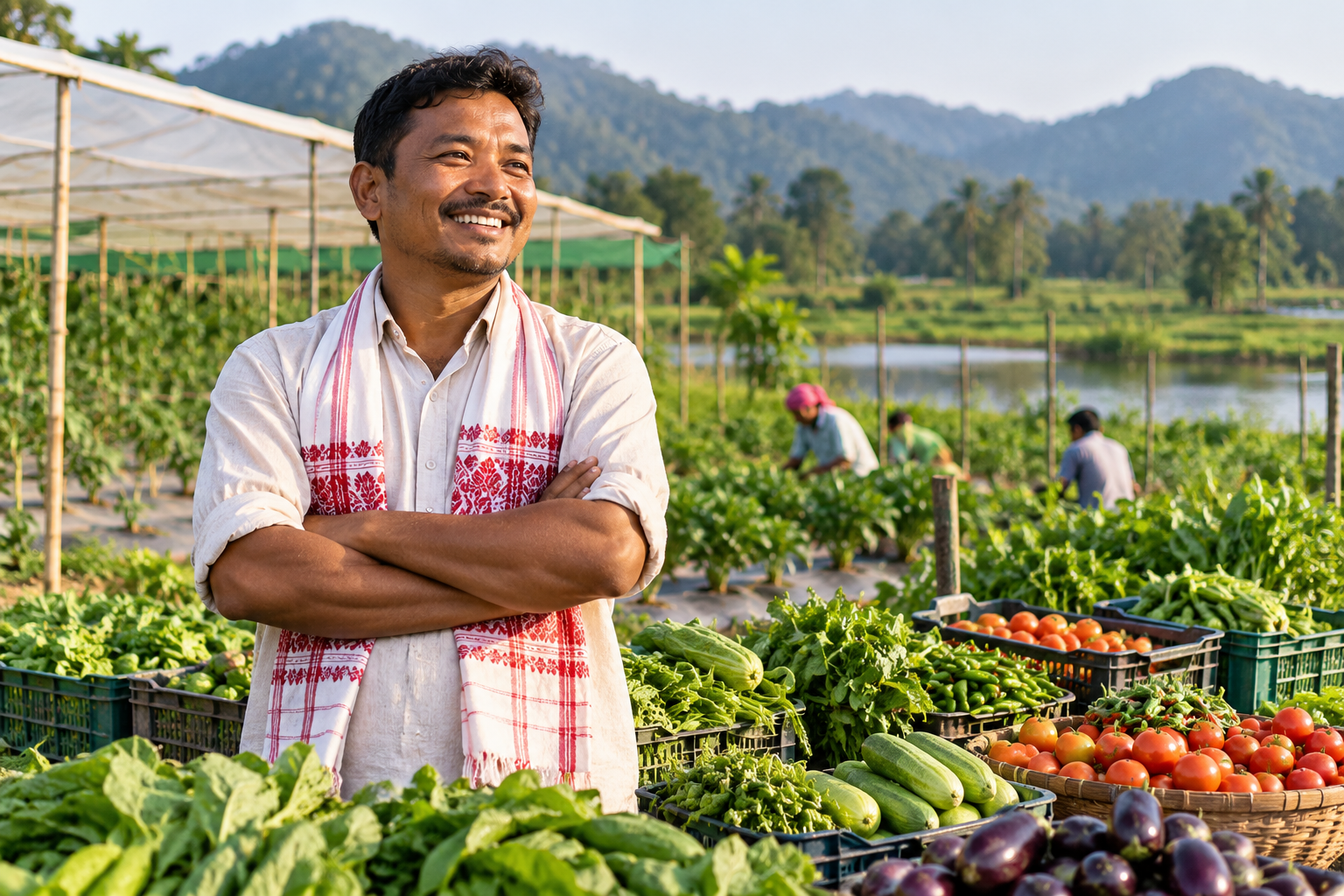
From earning a meagre Rs 6 a day as a teenage labourer to steering a farm that now records an annual turnover of up to Rs 80 lakh, Tileswar Handique’s transformation has become a touchstone for Assam’s agrarian renaissance. The former daily‑wage worker turned agro‑entrepreneur attributes his meteoric rise to a decisive encounter at a local banana market, where a single sale sparked a shift toward natural farming. Today, his 12‑hectare enterprise not only yields high‑value vegetables and indigenous crops but also serves as a living laboratory for sustainable practices, drawing farmers from across the Brahmaputra valley for training and exhibitions.
Key Context & Background
Handique’s story unfolds against a backdrop of chronic under‑employment and land fragmentation that have long plagued Assam’s rural economy. Since the 1990s, the state’s dependence on tea estates and low‑margin paddy cultivation has left a generation of youth with limited income alternatives, prompting mass migration to urban centres. Simultaneously, the Indian government’s “Paramparagat Krishi” (traditional farming) initiative, launched in 2015, incentivised organic methods and the revival of native seed varieties, creating a policy window for entrepreneurs willing to experiment beyond chemical‑intensive models. Handique, who dropped out of school at 15, leveraged these incentives, securing a modest loan under the Pradhan Mantri Formalisation of Micro Food Processing Enterprises (PM‑FME) scheme and converting a marginal plot inherited from his family into a pilot natural farm.
From Daily‑Wage to Agro‑preneur
The turning point arrived in 2018 when Handique, tasked with transporting a batch of bananas to a local market, negotiated a direct sale to a wholesale buyer, netting a profit that dwarfed his daily wage. Recognising the price premium attached to fresh, chemically‑free produce, he reinvested the earnings into high‑yielding, climate‑resilient varieties such as bhut jolokia, bitter gourd, and traditional millets. By adopting mulching, inter‑cropping, and rain‑water harvesting, he reduced input costs by 40 percent while enhancing soil health. Within three years, his diversified crop basket commanded premium rates in Guwahati’s organic bazaars, allowing the farm’s revenue to climb from a few thousand rupees to the eight‑figure bracket.
Broader Implications & Future Impact
Handique’s trajectory signals a potential paradigm shift for Assam’s agrarian sector. First, it validates the commercial viability of natural farming in a region traditionally dominated by chemical inputs, encouraging policy makers to expand credit lines and technical assistance for similar ventures. Second, his model demonstrates how small‑scale diversification can buffer farmers against climate volatility, a growing concern as the Brahmaputra basin experiences erratic monsoons and flooding. Third, the farm’s training workshops—now a regular feature at the district agricultural fair—have catalysed a ripple effect: over 200 local cultivators have adopted at least one organic practice, collectively reducing pesticide usage by an estimated 15 percent. If replicated, such diffusion could improve public health outcomes and lower the state’s agricultural carbon footprint.
Challenges Ahead and Scaling Prospects
Despite the success, Handique faces structural hurdles that could temper scaling ambitions. Market access remains fragmented; while metropolitan outlets pay premium prices, rural supply chains often lack the logistical capacity to move perishable produce efficiently. Additionally, the reliance on personal expertise raises questions about knowledge transfer once the founder steps back. To address these gaps, Handique is negotiating a partnership with a regional agri‑tech startup to digitise farm management and create a farmer‑to‑consumer platform. Such collaborations could institutionalise his practices, ensuring that the benefits of his model extend beyond the confines of his own fields and contribute to a more resilient, inclusive agricultural economy in Assam.