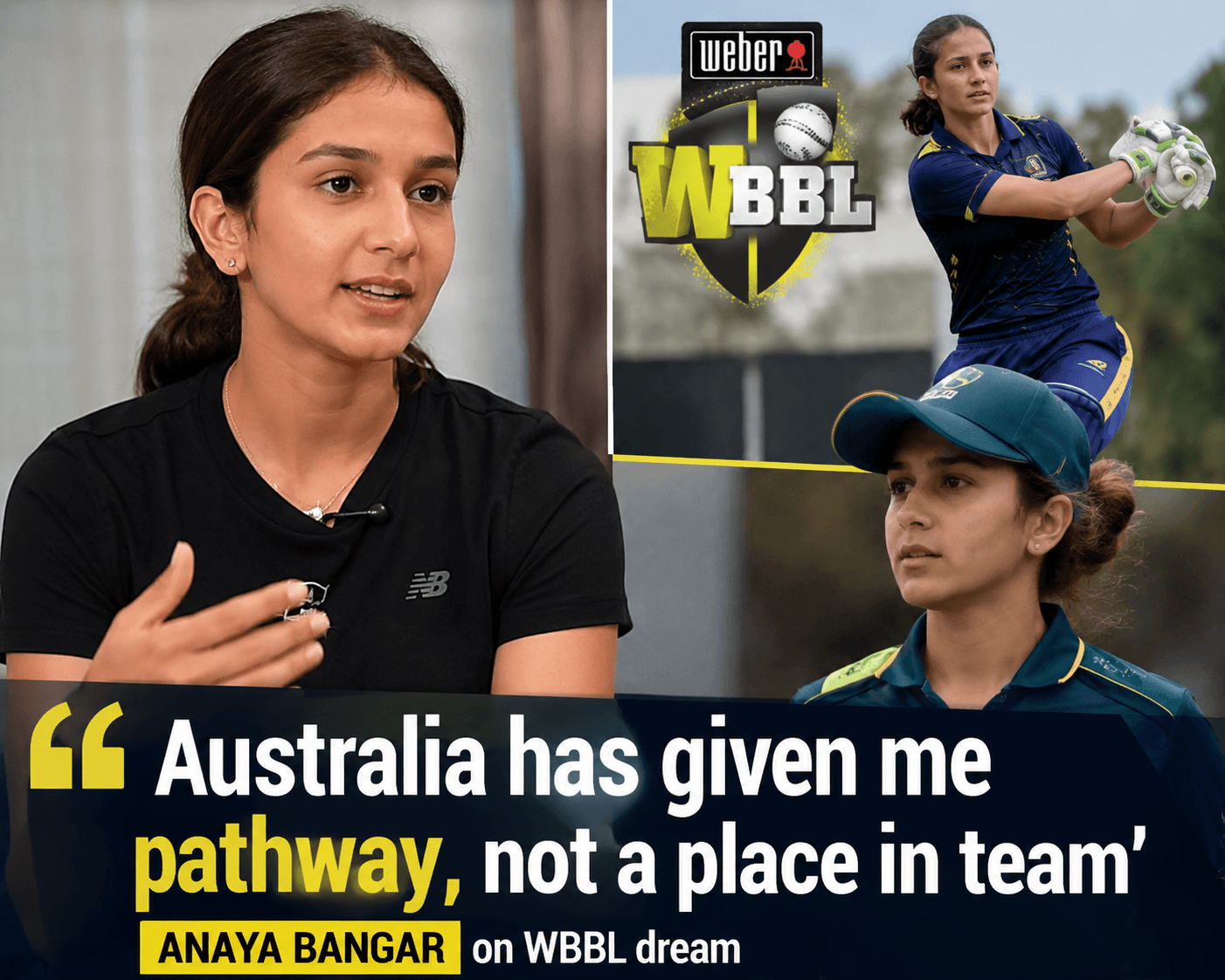
Anaya Bangar, a 22‑year‑old all‑rounder from Delhi, has announced a concrete plan to break into the Women’s Big Bash League (WBBL) by the 2026‑27 season, citing a newly formalised “pathway” offered by Cricket Australia. The pathway, unveiled in late 2023, promises overseas talent a structured route to domestic contracts, but it comes with strict medical and eligibility benchmarks that Bangar must satisfy. Her statement, “Australia has given me a pathway, not a place in the team,” underscores both the opportunity and the uncertainty that define the modern landscape of women’s cricket. The announcement arrives as the sport grapples with expanding professional opportunities while navigating complex gender‑policy debates.
Key Context & Background
The WBBL, launched in 2015, has become the premier T20 competition for women, attracting players from the Indian Premier League (IPL) and other domestic leagues. In recent years, Cricket Australia (CA) has faced pressure to diversify its talent pool and to provide clearer routes for overseas aspirants, a shift prompted by the International Cricket Council’s (ICC) push for a more global women’s calendar. The “Pathway Programme” introduced in 2023 was a response to criticism that non‑Australian players were relegated to ad‑hoc contracts, limiting their development and the league’s competitive balance. Simultaneously, CA has tightened its eligibility criteria, aligning with the ICC’s updated gender‑verification guidelines that require regular testosterone monitoring and comprehensive blood panels for all players, regardless of nationality.
Pathway Details & Eligibility Criteria
Bangar’s roadmap hinges on three pillars: performance in Australia’s state‑level women’s leagues, compliance with CA’s medical standards, and a minimum two‑year residency period before she can be considered for a WBBL contract. The medical standards, often described as “rigorous,” include quarterly testosterone level checks and a full blood workup to verify the absence of any prohibited substances. While these measures are framed as protecting player health and ensuring a level playing field, they have sparked debate among athletes and advocacy groups who argue that they impose an additional burden on women from regions where such testing is not routine. For Bangar, meeting these thresholds is non‑negotiable; failure would mean returning to the Indian domestic circuit without the prospect of an overseas breakthrough.
Broader Implications & Future Impact
If Bangar succeeds, her case could become a template for a new generation of South Asian talent seeking to ply their trade in the WBBL, potentially reshaping recruitment strategies across the league. A steady influx of high‑calibre overseas players would elevate the competition’s standard, attracting larger broadcast deals and sponsorships, which in turn could accelerate the professionalisation of women’s cricket in both Australia and the sub‑continent. Conversely, the stringent eligibility regime may deter some aspirants, reinforcing a de‑facto barrier that privileges athletes already embedded in Western sports medicine infrastructures. The tension between inclusivity and regulatory rigor is likely to influence future policy revisions by the ICC and national boards, especially as gender‑verification protocols become a focal point of broader debates about bodily autonomy in sport.
Personal Drive & Training Regimen
Beyond administrative hurdles, Bangar’s commitment to a year‑round conditioning program reflects a growing professional ethic among emerging women cricketers. She has relocated to Melbourne to train under former Australian fast‑bowler Shaun Tait, focusing on pace development, spin variation, and fielding agility—skills identified by CA scouts as critical for WBBL success. Her daily schedule blends gym work, video analysis of elite batters, and simulated match scenarios, illustrating how individual ambition now intersects with institutional pathways. As Bangar puts it, “Dedication and performance are the keys; the pathway is just the map.” Her journey, therefore, encapsulates the evolving dynamics of talent migration, regulatory oversight, and the relentless pursuit of sporting excellence in a rapidly professionalising women’s game.