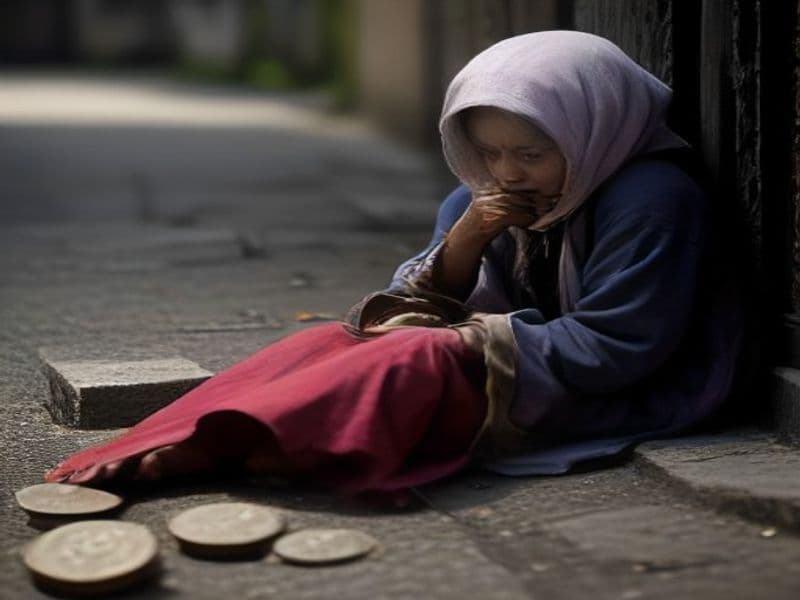
A 69‑year‑old beggar named Noor died in the town of Mandya, Karnataka, leaving behind a startling financial legacy: Rs 8.40 lakh saved in a bank account and countless coins stored in battered bags. The discovery, made by relatives and neighbours who handled her modest possessions after her death, has sparked a wave of curiosity and empathy across the region. While the immediate story is one of a solitary life ending with dignity, the hidden wealth raises questions about the informal saving habits of India’s most vulnerable and the social safety nets that fail to reach them.
Key Context & Background
Begging remains a visible yet largely undocumented component of India’s informal economy, estimated to involve millions who survive on daily alms, occasional odd jobs, and the occasional charity from well‑meaning strangers. Historically, street‑level workers have relied on cash savings—often in the form of coins—because formal banking services are perceived as inaccessible or intimidating. In recent years, however, the government’s push for financial inclusion through Jan Dhan accounts has nudged a segment of this population toward bank deposits, albeit in modest amounts. Noor’s case illustrates how a combination of traditional cash hoarding and limited banking engagement can accumulate a sizeable sum over decades, especially when earnings, however irregular, are consistently set aside.
Mandya’s economy, anchored in sugarcane cultivation and small‑scale industry, has faced periodic downturns that push marginal workers into precarious livelihoods. During lean seasons, many turn to begging as a stop‑gap, supplementing income from seasonal labor. The cultural practice of “saving in jars”—collecting loose change for future emergencies—has deep roots in Indian households, extending to those living on the streets. Noor’s bag of coins, reportedly spanning denominations from one‑rupee to two‑rupee pieces, reflects this long‑standing habit, while her modest bank balance indicates a tentative embrace of formal financial tools, possibly facilitated by a local NGO or a sympathetic bank officer.
Personal Narrative & Social Resonance
Neighbors recall Noor as a quiet figure who traversed the town’s main thoroughfare each morning, offering a polite smile to passing commuters. Those who knew her speak of an unspoken routine: she would collect stray change from vending stalls, tuck it into worn cloth pouches, and occasionally visit the local branch of a public sector bank to deposit surplus funds. Family members, who had been estranged for years, converged at her funeral, their presence underscoring the complex social ties that bind even the most marginalized. The revelation of her savings has prompted a wave of introspection among locals, many of whom admit that they, too, keep hidden caches of cash, fearing the volatility of informal income streams.
The emotional response extends beyond Mandya. Social media platforms have amplified Noor’s story, with commentators highlighting the paradox of a beggar amassing wealth that could have altered her quality of life. Some view her savings as a testament to personal resilience, while others see it as a stark indictment of a system that forces individuals to self‑insure against poverty without adequate support.
Broader Implications & Future Impact
Noor’s hidden fortune spotlights a broader policy dilemma: how to integrate the most vulnerable into formal financial ecosystems without eroding their cultural saving practices. The episode could galvanize local authorities to launch targeted outreach programs, pairing micro‑savings accounts with financial literacy workshops designed for street‑level workers. Moreover, the case may prompt banks to reconsider account‑opening procedures, simplifying KYC requirements for individuals lacking traditional identification documents.
On a societal level, the narrative challenges prevailing stereotypes that equate visible poverty with financial desperation. It suggests that many in the informal sector possess latent capital, which, if mobilized responsibly, could feed into micro‑enterprise initiatives, community cooperatives, or pension schemes for the elderly. Policymakers might therefore explore mechanisms to unlock such dormant assets—perhaps through low‑interest micro‑loans or matched‑saving programs—thereby converting personal thrift into collective economic uplift.
In the longer term, Noor’s story could serve as a catalyst for research into the “shadow savings” of India’s poorest, an area currently under‑examined by economists. Understanding the scale and composition of these informal reserves may reshape how governments design social security nets, ensuring that assistance complements, rather than supplants, the self‑reliant strategies that many marginalized citizens have honed over a lifetime.