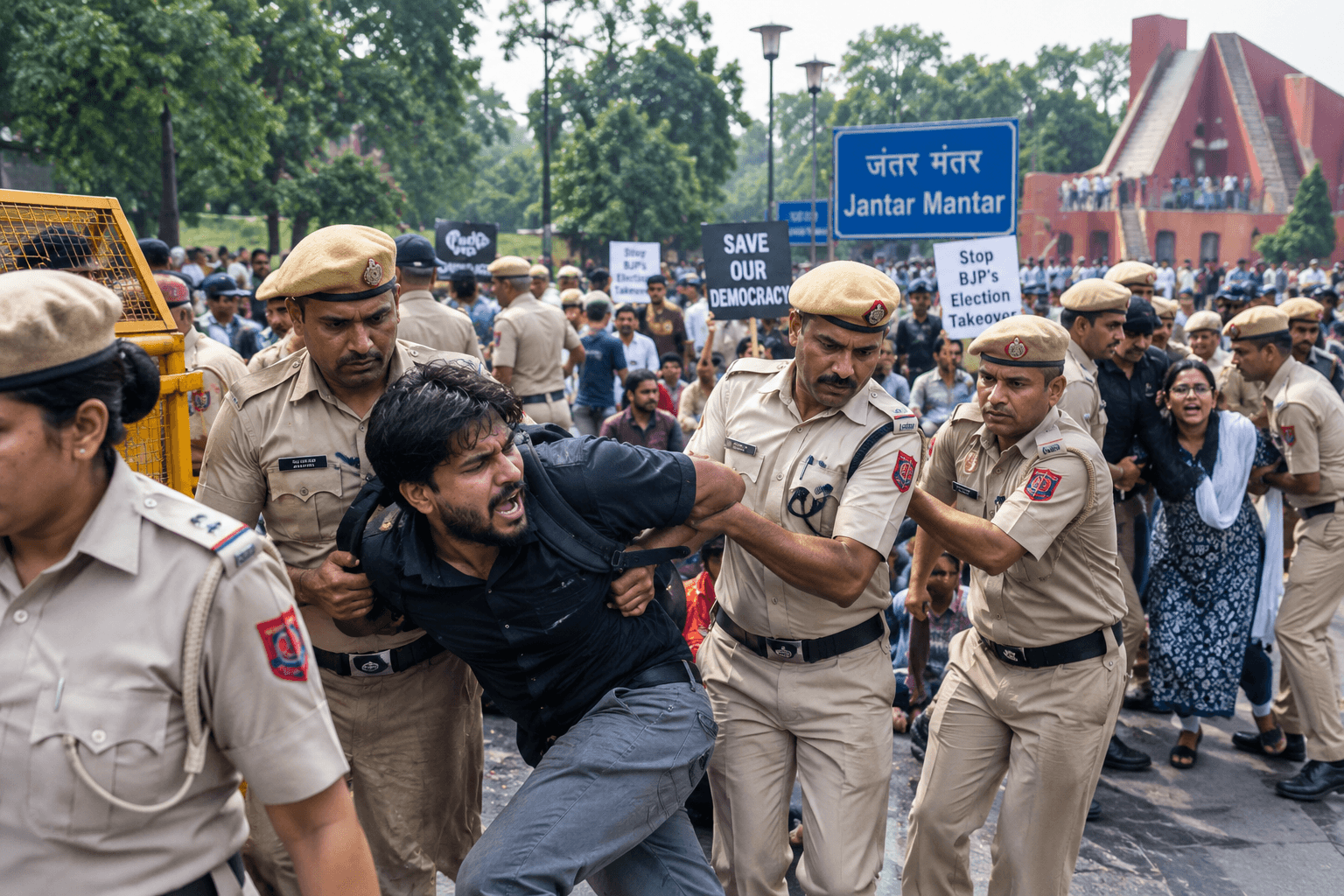
Delhi police detained roughly 1,000 demonstrators at Jantar Mantar on Tuesday, after a large‑scale protest demanding the resignation of Election Commission of India (ECI) chief Rajiv Kumar. The gathering, organized by a coalition of civil‑society groups and opposition parties, alleged irregularities in the Special Intensive Revision (SIR) of electoral rolls that, according to them, led to the mass deletion of legitimate voters. While many detainees were later released, the episode has reignited a contentious debate over the transparency of India’s voter‑list cleaning process and the political leverage of the country’s electoral watchdog.
Key Context & Background
The Special Intensive Revision, launched in early 2024, is the ECI’s most ambitious effort to purge duplicate, deceased, or otherwise ineligible entries from the nation’s electoral rolls. While the commission claims the exercise will improve the integrity of elections, critics point to a sharp rise in the number of deletions—over 4 million names were removed in the first phase alone. Opposition leaders allege that the criteria used were vague, allowing political operatives to target swing constituencies. Historically, India has grappled with roll‑cleaning controversies; the 2013 “Voter Veracity” drive faced similar accusations of partisan bias, prompting a judicial review that temporarily halted the process.
Legal and Political Reactions
Following the mass detention, several high‑profile politicians, including the leader of the opposition in the Lok Sabha, lodged petitions in the Supreme Court seeking an interim stay on the SIR. The court has so far refused to intervene, citing the ECI’s constitutional autonomy. Meanwhile, the Ministry of Home Affairs defended the police action as a necessary measure to prevent “law‑and‑order disruptions” at a historic protest site. Civil‑rights groups, however, argue that the detentions amount to a suppression of dissent, invoking provisions of the Right to Freedom of Speech and Assembly under Article 19 of the Indian Constitution.
Broader Implications & Future Impact
The fallout from the Jantar Mantar protest could reshape the political calculus ahead of the 2025 general elections. If the allegations of voter‑list manipulation gain traction, they may erode public confidence in the ECI, a body traditionally viewed as the linchpin of India’s democratic stability. International observers have already flagged the episode in their pre‑election assessments, warning that perceived electoral engineering could affect India’s standing in global democracy indexes. Domestically, the incident may prompt legislative scrutiny; several MPs have called for an amendment to the Representation of the People Act to introduce an independent oversight committee for roll‑cleaning exercises.
What Lies Ahead for the Election Commission
The ECI now faces a dual challenge: completing the SIR without further inflaming political tensions, and restoring its credibility among a skeptical electorate. Experts suggest that greater transparency—such as publishing detailed criteria for deletions and allowing affected voters a streamlined appeal mechanism—could mitigate accusations of bias. Moreover, the commission’s handling of the protest may set a precedent for how future civil‑society actions are managed, balancing the need for public order with constitutional freedoms. As the nation watches, the resolution of this standoff will likely become a benchmark for the robustness of India’s democratic institutions in an era of heightened political polarization.