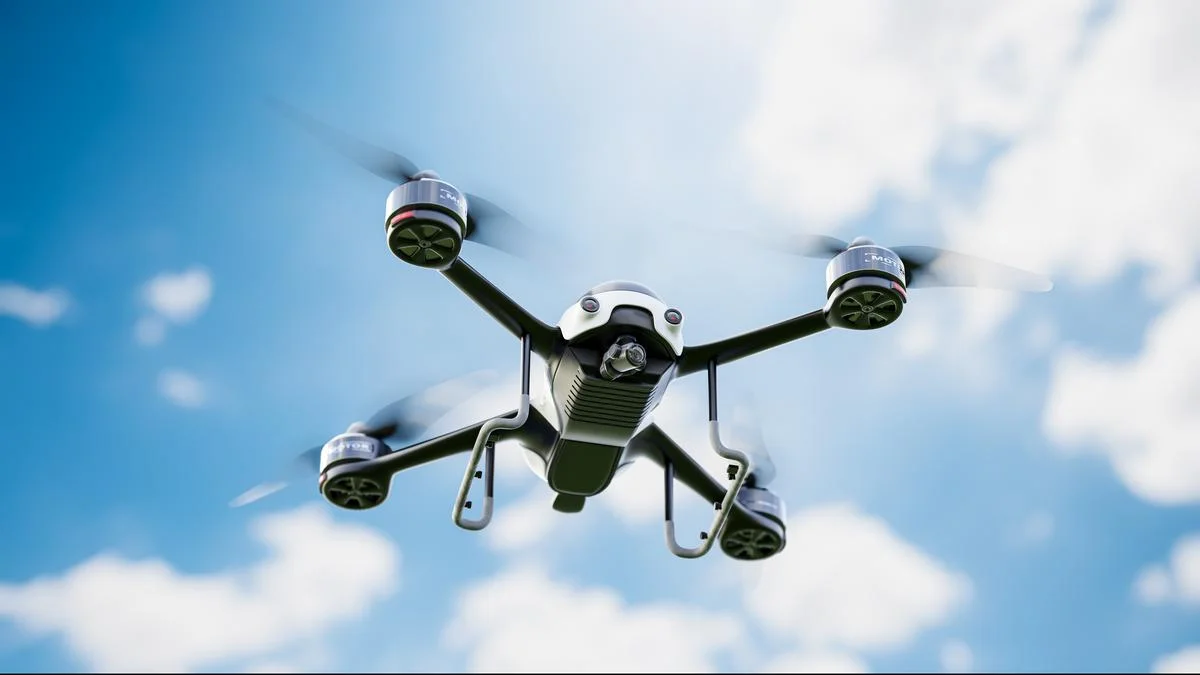
Drone-mounted radars to see through dense forest cover
The Indian Army has initiated a procurement proposal under the Make II category — where Indian industry develops technology using its own funds — for indigenous drone-mounted radars capable of detecting human movement beneath dense forest canopy. The requirement is driven directly by counter-insurgency operations in Jammu & Kashmir and the northeast, where thick foliage provides cover for militant movement and hideouts and where continuous satellite coverage and existing sensors fall short. The Army has cited the months-long search for those responsible for the Pahalgam terror attack — who were eventually tracked down in the dense Dachigam forest during Operation Mahadev — as an example of the operational gap this system is meant to close. According to reporting citing the Army's specifications, the radar is expected to be integrated with a lightweight unmanned aerial platform weighing no more than 20 kilograms, with an endurance of 60 to 120 minutes.
BAE Systems eyes local production of the Tridon Mk 2
BAE Systems is evaluating a partnership with Indian industry to manufacture its Tridon Mk 2 mobile air-defence system locally, Tony Walton, the newly appointed managing director of BAE Systems India, told the defence publication Janes on July 21. The Swedish-made system — built around a newly developed version of the Bofors 40mm gun and first shown publicly at the Eurosatory 2024 exhibition in Paris — is designed to counter UAVs and other low-altitude aerial threats as part of India's push for Very Short-Range Air Defence (V-SHORADS) capability. It's worth being clear about the stage this is at: BAE Systems has not disclosed whether specific Indian companies have been shortlisted or whether formal discussions have begun, and local production would depend on India selecting the system for procurement in the first place. "We are open to all options and will meet the Indian Army's requirements in collaboration with Indian companies," a company spokesperson said, adding that the end objective is for the guns to reach the Indian Army through an Indian partner.
A correction on the Sigma Advanced Systems export order
Hyderabad-based Sigma Advanced Systems has indeed secured a major export contract for 155mm base-bleed artillery shell bodies to a North American customer — but the contract value is dramatically larger than ₹13 crore. According to the company's own disclosure, the order is worth approximately $104.9 million, or roughly ₹1,013 crore, covering next-generation extended-range 155mm base-bleed artillery shells. This follows an earlier, separate export order the company secured in June 2026, worth around ₹208 crore for 40,000 units of 155mm M107 shell bodies to a different North American customer. If citing a specific figure for this story, ₹1,013 crore (for the base-bleed shell order) is the figure that matches the shell type described — the ₹13 crore figure does not match any disclosed Sigma Advanced Systems contract and should be corrected before publishing.
Zen Technologies unveils a high-altitude anti-drone system
Zen Technologies unveiled what it described as India's first High-Altitude Man-Portable Anti-Drone System (MPADS) on July 26, timed to coincide with Kargil Vijay Diwas. The system combines RF detection, data fusion, and omni-directional jamming in a configuration light enough to be carried by soldiers, pack animals, or vehicles in mountainous and remote terrain. Specifications disclosed by the company include drone detection out to 5 km via wideband RF scanning across the 400 MHz–6 GHz spectrum, and jamming range of up to 3 km capable of disrupting both drone command links and GNSS signals simultaneously, with claimed multi-target and swarm detection capability. At its core is the company's RF-Based Drone Detector, using correlative interferometry and digital beamforming to determine the bearing of hostile drones, feeding into a Data Fusion & Command Centre for threat classification and engagement decisions.
IAF's Sureshastra loitering munition — a note on the range figures
Delhi-based Veda Aeronautics has been delivering its catapult-launched, jet-powered Sureshastra Mk1 loitering munition to the Indian Air Force, with first units delivered in April 2026 under what's described as the largest order for loitering munitions the Indian military has placed with the private sector. The system is compact for a jet-powered platform — around 3.5 metres long with a 3-metre wingspan and roughly 90 kg in weight — and can navigate in GPS-denied environments, functioning either as a decoy or in a strike role. Reported range figures for the Mk1 vary meaningfully across sources: earlier reporting put its range at "more than 150 km," while more recent coverage describes delivered units flying "over 500 kilometres," comparing it to Russia's Geran-5 (itself derived from the Iranian Shahed-136). Given this inconsistency, and that no independent reporting reviewed for this article specifically confirmed a distinct "Mk2" variant with its own separate range figure, the specific 300 km (Mk1) and 500km+ (Mk2) breakdown should be verified against a primary IAF or Veda Aeronautics source before publishing — it's possible the 500km+ figure describes the Mk1 itself rather than a more advanced successor variant.