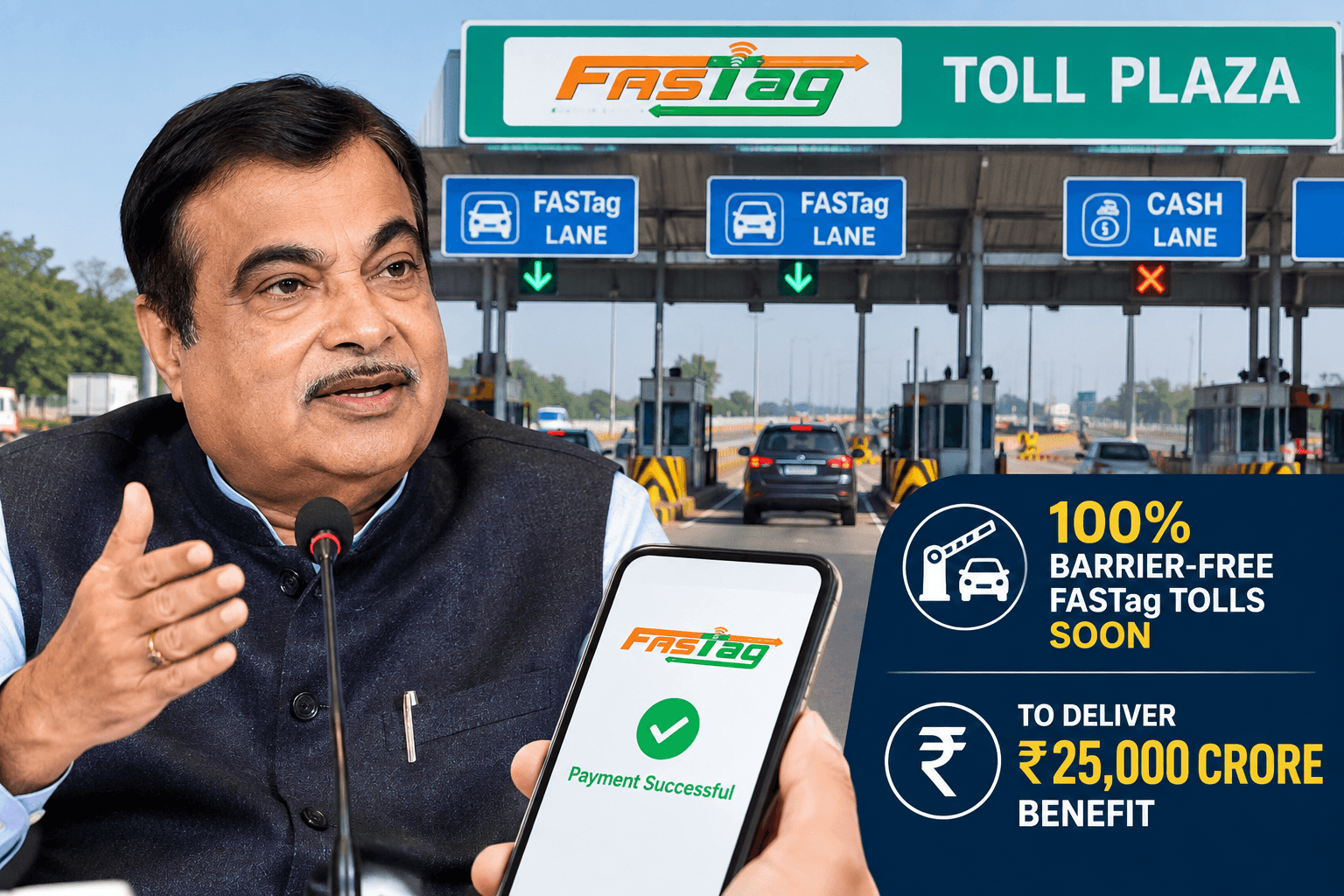
The Ministry of Road Transport and Highways announced on Thursday that every toll plaza on India’s national highway network will become fully barrier‑free by March 2027, with 100 % FASTag compliance mandated for all vehicles. Minister Nitin Gadkari highlighted that the electronic toll collection system has already lifted toll revenues by roughly 10 %—an increase of about ₹7,000 crore—pushing total collections past ₹82,000 crore. He projected an additional ₹25,000 crore in economic benefit once the barrier‑free rollout is complete, underscoring a decisive shift toward digital, cash‑less mobility.
Key Context & Background
FASTag, introduced in 2017, was initially a pilot on select high‑traffic corridors and faced resistance due to limited awareness, inadequate RFID infrastructure, and the entrenched cash‑based culture at toll plazas. Over the past three years, the government’s aggressive push—backed by subsidies for tag purchase, mandatory tag‑on‑boarding for new vehicle registrations, and the integration of FASTag data with the National Payments Corporation of India—has transformed adoption rates to over 85 % of registered vehicles. Simultaneously, the pandemic accelerated digital payment preferences, while the Ministry’s “Digital India” agenda created policy synergies that made electronic toll collection a national priority.
Economic Rationale & Expected Savings
The projected ₹25,000 crore benefit stems from multiple cost‑saving vectors. First, eliminating physical barriers reduces manpower expenses at over 1,300 toll plazas, cutting recurring salaries and overtime pay. Second, faster vehicle processing diminishes fuel consumption and idling emissions, translating into indirect savings for transport operators and the environment. Third, the digital ledger created by FASTag enables real‑time revenue reconciliation, curbing leakages and fraud that historically plagued cash‑based systems. Collectively, these efficiencies are expected to lower logistics costs, improve supply‑chain reliability, and enhance the competitiveness of Indian manufacturing on global markets.
Broader Implications & Future Impact
Beyond immediate fiscal gains, a fully barrier‑free toll network positions India to integrate advanced traffic‑management platforms, such as AI‑driven congestion pricing and dynamic lane allocation. The data stream generated by FASTag can feed into national transportation dashboards, informing infrastructure investment decisions and emergency response coordination. Moreover, the move aligns with the country’s climate commitments by reducing vehicle emissions at bottlenecks, a factor that could be quantified in future carbon‑credit schemes. For the average commuter, the promise of seamless, cash‑free travel may also shift public expectations toward broader digital services in the mobility ecosystem, including e‑vehicle charging and smart parking.
Challenges & Implementation Roadmap
Achieving 100 % barrier‑free status by 2027 will require addressing lingering infrastructure gaps in remote stretches of the highway network, where power supply and internet connectivity remain unreliable. The Ministry has earmarked a ₹3,500 crore fund for upgrading RFID readers, solar‑backed power units, and high‑speed broadband links at these outposts. Additionally, a phased enforcement plan will penalize non‑compliant toll operators while offering technical assistance to smaller private concessionaires. Stakeholder coordination—between central and state governments, toll‑operating companies, and fintech partners—will be critical to prevent service disruptions during the transition.