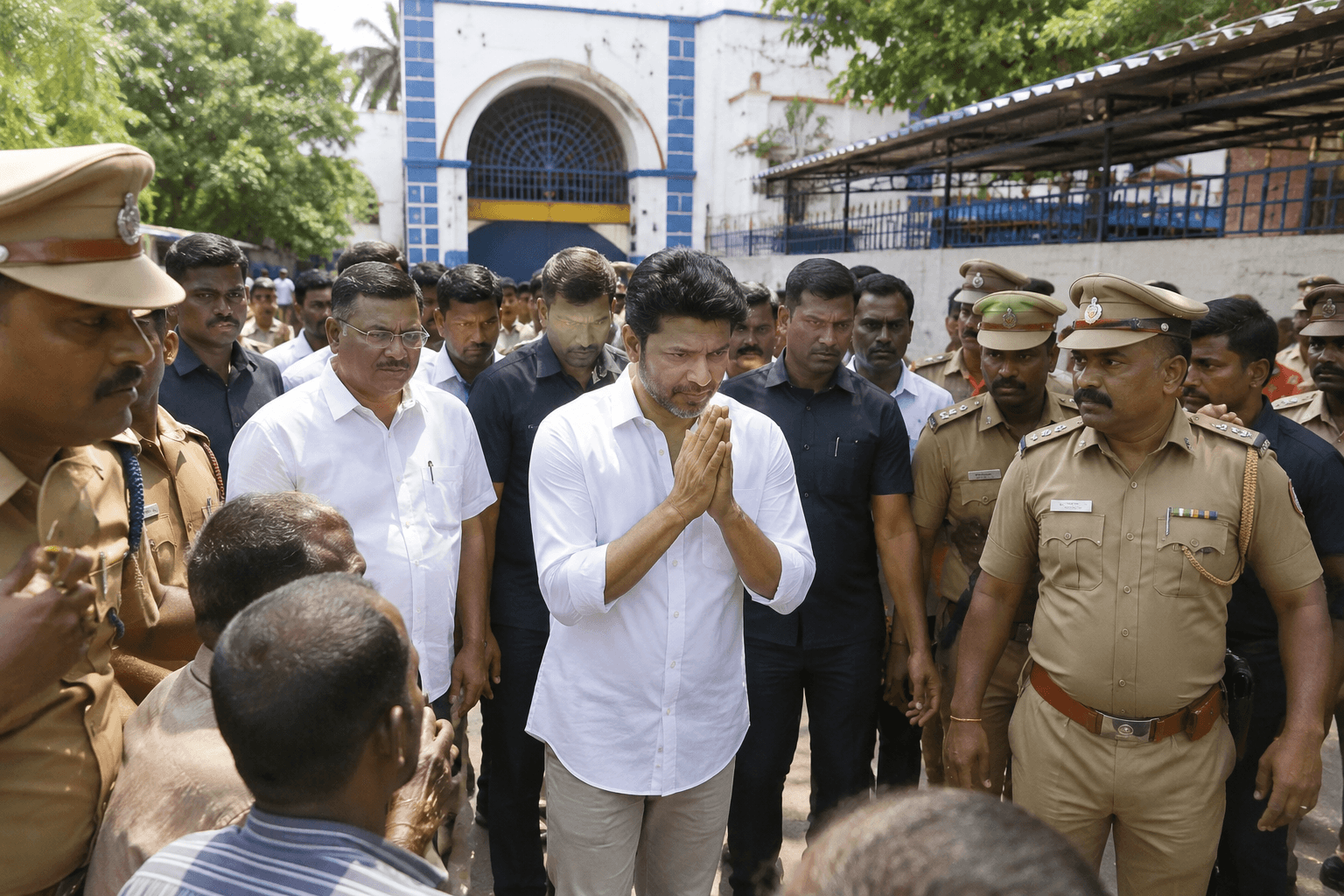
Chennai’s chief minister, C Joseph Vijay, toured the Puzhal Central Prison on Friday, using the visit to press for a systematic upgrade of rehabilitation and vocational‑training programmes for inmates. The walk‑through, which included the kitchen, medical wing and library, was timed to follow a heated debate in the state assembly over the prison department’s demand for a larger grant. By foregrounding literacy and skill‑building, the chief minister signalled a shift from punitive confinement toward a more restorative model, a move that could reshape Tamil Nadu’s correctional landscape.
Key Context & Background
Tamil Nadu’s prison system has long wrestled with chronic overcrowding; Puzhal, the state’s largest facility, houses more than 5,000 inmates in a complex designed for roughly 3,800. The surge is tied to a combination of stricter drug‑related statutes, a backlog in the courts and an expanding definition of “economic offences.” In the last two legislative sessions, opposition parties and civil‑society groups have repeatedly highlighted the deteriorating health conditions, inadequate medical care and the scarcity of educational resources inside the walls. The prison department’s recent demand for an additional ₹1.2 billion in funding was framed as a response to these systemic pressures, while also positioning the department as a key stakeholder in the state’s broader public‑safety agenda.
Rehabilitation Initiatives and Policy Shifts
Vijay’s emphasis on reading material and vocational training aligns with a growing national discourse that views correctional facilities as “skill‑development hubs.” The chief minister cited successful pilot programmes in Kerala and Karnataka, where partnerships with local industries have reduced recidivism by up to 15 percent. In Puzhal, however, the infrastructure for such programmes remains rudimentary: a single library with limited titles, no dedicated workshops, and a kitchen that doubles as a makeshift training ground for culinary skills. By urging the prison authorities to expand the library’s collection and formalise trade‑skill curricula, the visit could catalyse a reallocation of the pending grant toward concrete, outcome‑based projects rather than mere operational costs.
Critics caution that without a robust monitoring framework, new initiatives risk becoming token gestures. The state’s prison reform bill, still pending in the assembly, proposes an independent oversight committee to audit training outcomes and ensure that contracts with private trainers are transparent. If enacted, the bill could provide the administrative backbone needed to translate Vijay’s rhetoric into measurable change.
Broader Implications & Future Impact
The visit carries weight beyond the confines of Puzhal. A demonstrable shift toward rehabilitation could reshape public perception of inmates, framing them less as “dangerous elements” and more as individuals caught in socio‑economic cycles. This narrative may influence electoral calculus, as voters increasingly demand humane governance. Moreover, a successful model could attract central‑government funding under the “Skill Development for Inmates” scheme, positioning Tamil Nadu as a benchmark for other high‑populated states.
Economically, equipping prisoners with market‑relevant skills could ease the state’s labor shortages in sectors such as hospitality, construction and textiles. Early studies suggest that each inmate who secures formal employment within six months of release can generate an estimated ₹250,000 in taxable income annually, offsetting incarceration costs. Socially, reduced recidivism would alleviate pressure on the already strained judicial system, allowing courts to focus on more complex cases.
Nonetheless, the road ahead is fraught with challenges. Funding allocations must be protected from bureaucratic dilution, and the quality of training must meet industry standards to avoid creating a “prison‑factory” of underqualified workers. If the state can navigate these pitfalls, Vijay’s Puzhal tour may mark the beginning of a paradigm shift—one that reimagines prisons as engines of social reintegration rather than mere detention facilities.