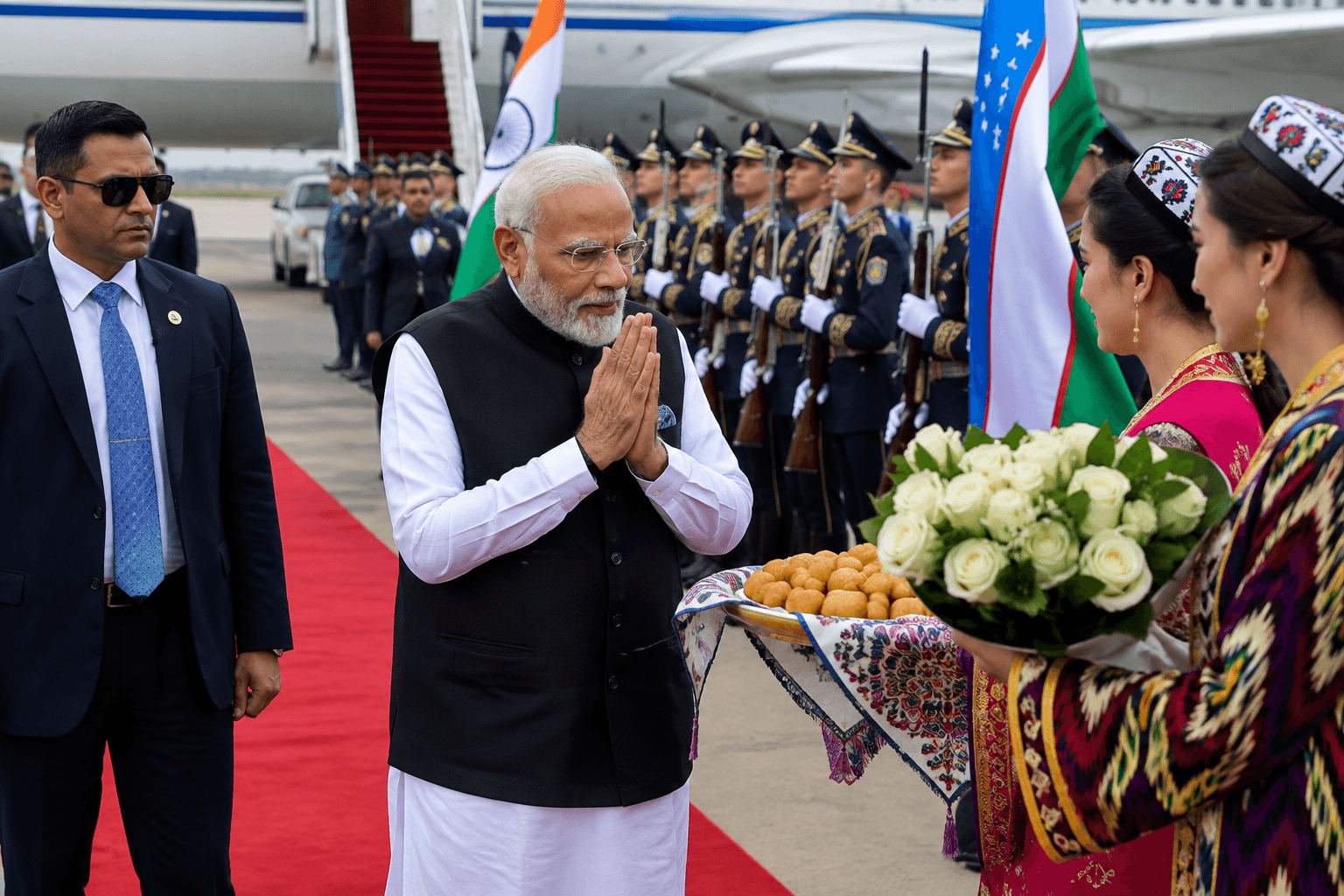
Prime Minister Narendra Modi set foot in Tashkent on Monday, launching a four‑day diplomatic trek that will see him meet Uzbek President Shavkat Mirziyoyev before heading to Bishkek for the 26th Shanghai Cooperation Organisation (SCO) summit. The visit, timed to coincide with the first SCO gathering since the bloc’s expansion to include India, signals New Delhi’s intent to deepen strategic ties across Central Asia, a region that has become a focal point of competing great‑power interests. By coupling bilateral talks with multilateral engagement, Modi aims to position India as a reliable partner in a landscape traditionally dominated by Russia, China and, increasingly, the United States.
Key Context & Background
India’s outreach to Central Asia is rooted in a blend of historic trade routes, energy security concerns, and a strategic calculus that seeks to counterbalance Beijing’s Belt and Road Initiative (BRI). Since the early 2000s, New Delhi has pursued “Connect Central Asia” as a policy pillar, but progress was hampered by logistical bottlenecks and limited infrastructure. The 2021 accession of India to the SCO marked a watershed, granting it a formal platform to dialogue with the region’s key players, including Russia and China, while also providing a venue to promote its own “Act East” agenda.
Uzbekistan, under Mirziyoyev’s reformist banner, has been recalibrating its foreign policy away from exclusive reliance on Russian and Chinese investments toward a more diversified partnership model. The country’s recent liberalisation of its banking sector, easing of visa regimes, and pursuit of renewable‑energy projects have opened doors for Indian firms in construction, pharmaceuticals, and information technology. Kyrgyzstan, meanwhile, remains a geopolitical hinge, hosting the SCO’s headquarters and grappling with debt‑laden infrastructure projects largely financed by China.
Agenda & Bilateral Priorities
In Tashkent, Modi is expected to sign a series of memoranda covering energy cooperation, digital connectivity, and defence training. A focal point will be the proposed India‑Uzbek joint venture on solar‑power parks in the Samarkand region, which could supply clean electricity to both nations and reduce reliance on fossil‑fuel imports. Defence officials will likely discuss expanding the existing joint‑exercise framework, building on the 2022 “Vajra‑Sanjivani” drills that marked the first Indian‑Uzbek naval cooperation.
The SCO summit in Bishkek will broaden the conversation to security challenges such as terrorism in Afghanistan, illicit trafficking across the Pamir corridor, and the evolving cyber‑threat landscape. India’s push for a more active role in SCO decision‑making—particularly on counter‑terrorism coordination—reflects its concern over spill‑over effects from the Afghan crisis and its desire to shape a collective response that does not default to Russian or Chinese dominance.
Broader Implications & Future Impact
If successful, Modi’s Central Asian tour could catalyse a new axis of economic and security cooperation that rebalances regional power dynamics. For India, deeper market access to Uzbekistan’s burgeoning manufacturing base and Kyrgyzstan’s mineral wealth would diversify supply chains that are currently over‑dependent on Chinese routes. Moreover, a visible Indian presence at the SCO could encourage other non‑regional actors, such as the European Union and Japan, to engage more assertively, potentially turning the organisation into a more pluralistic forum.
However, the venture is not without risks. Russia’s waning influence in the post‑Ukraine war environment may create a vacuum that China is eager to fill, especially through infrastructure loans tied to the BRI. India’s diplomatic overtures must therefore navigate a delicate equilibrium—offering development assistance without appearing to undermine the existing Russian‑Chinese partnership that many Central Asian states still value. The outcome of the summit will likely set the tone for India’s long‑term strategic posture: whether it can emerge as a credible third pole in Central Asia or remain a peripheral player in a space increasingly defined by great‑power competition.