Unveiling Ancient Biodiversity: Scientists Discover 4.5-Million-Year-Old Freshwater Fish Fossils in India
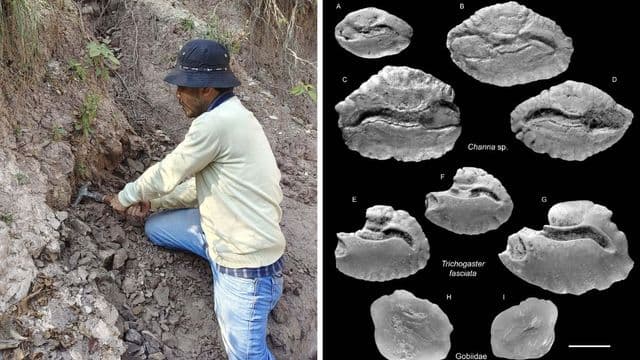
Researchers from the Wadia Institute of Himalayan Geology (WIHG) have made a groundbreaking discovery, unearthing freshwater fish fossils in the Mohand area of the Shivalik foothills, near Dehradun. The fossils, dating back around 4.5 million years to the Pliocene epoch, provide significant insights into the region's ancient biodiversity and ecosystem dynamics.
The team of scientists discovered ooliths or ear bones of three distinct fish groups: Snakehead (Channa), Gobi (Gobiidae), and Gourami (Trichogaster fasciata). Notably, the Gourami fossil is only the second such finding globally, with the first discovered in Sumatra, Indonesia. This remarkable discovery sheds light on the Mohand region's past, revealing that it once had a slow-moving or stagnant freshwater ecosystem, likely a lake or pond, with dense vegetation.
Shivalik Hills: A Treasure Trove of Fossils
The Shivalik hills, a mountain range in northern India, are renowned for their rich fossil deposits, particularly terrestrial animal fossils. However, the recent discovery marks the first strong evidence of a freshwater aquatic ecosystem in the region, challenging the long-held assumptions about the area's paleoenvironmental conditions.
The Pliocene epoch, during which the fossils date back, was a significant period in the Earth's history, marked by a gradual shift from a warm, humid climate to a more arid environment. This transition likely had a profound impact on the region's ecosystems, including the formation of freshwater lakes and ponds, which in turn supported a diverse array of aquatic life.
Implications for Ancient South Asian Biodiversity
The discovery of these ancient freshwater fish fossils has far-reaching implications for our understanding of South Asian biodiversity. The presence of these fish groups in the Mohand region suggests that the region's aquatic ecosystem was once more complex and diverse than previously thought.
This finding also highlights the importance of preserving and studying the region's fossil deposits, which hold secrets to the region's ancient history. The WIHG team's discovery underscores the need for continued research and exploration of the region's fossil records, which will undoubtedly shed more light on the region's fascinating past.
Conclusion
The discovery of 4.5-million-year-old freshwater fish fossils in the Mohand area of the Shivalik foothills is a significant milestone in the field of paleontology. This finding not only expands our knowledge of ancient South Asian biodiversity but also underscores the importance of preserving and studying the region's fossil deposits. As researchers continue to unravel the secrets of the region's past, we can expect to uncover even more fascinating insights into the evolution of life on our planet.