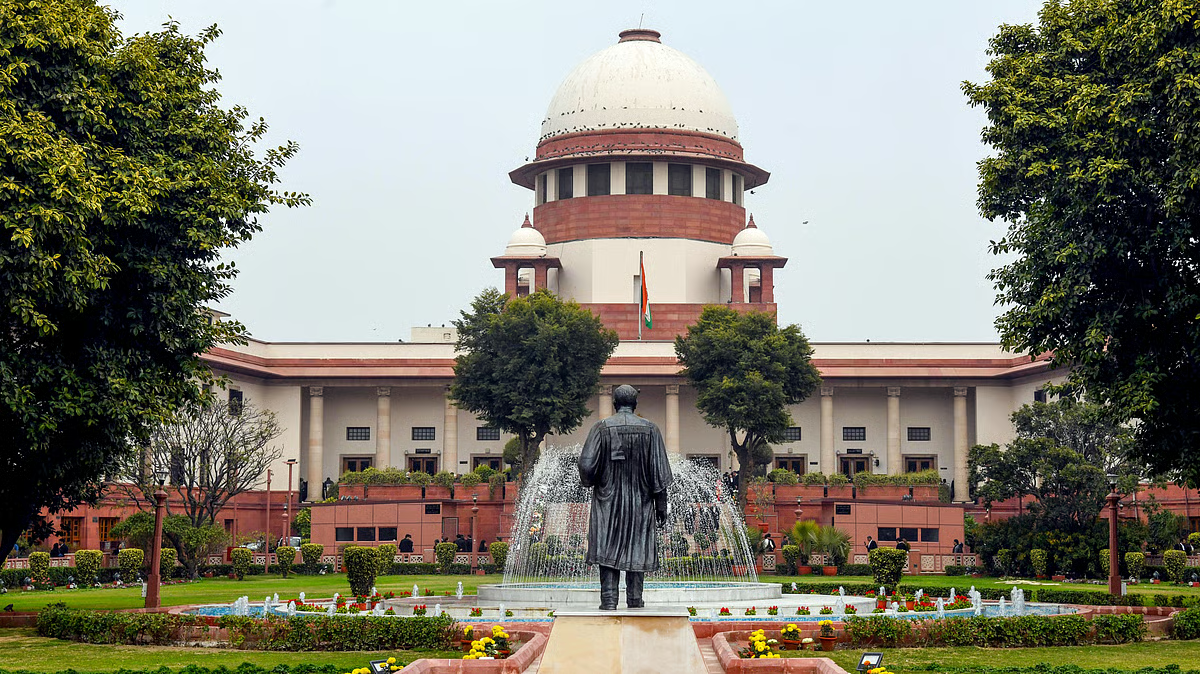
The controversy surrounding the alleged NEET-UG 2026 paper leak has intensified after the Supreme Court declined to urgently hear a petition seeking judicial intervention over police action against student protesters in Delhi. The decision has further fueled the political battle between the government and the opposition, with both sides accusing each other of politicizing the issue.
The petition was mentioned before a bench led by Chief Justice of India (CJI) Surya Kant. The petitioners requested urgent intervention over allegations of excessive police force during the "Chalo Sansad" protest march held on July 20, where thousands of students and supporters attempted to march from Jantar Mantar towards Parliament. However, the Supreme Court declined to grant an urgent hearing.
"The court was not interested in examining videos at the mentioning stage and declined to prioritize the matter for urgent listing."
During the mentioning of the matter, the petitioner's counsel referred to videos allegedly showing police excesses. Responding to the request, CJI Surya Kant remarked that the court was "not interested in videos" and that it did not have time to examine such material at the mentioning stage. The bench also refused to prioritize the matter for immediate listing.
The Supreme Court's response came a day after the Delhi High Court also declined to urgently hear a similar plea concerning the police crackdown, indicating that the matter would proceed through the normal judicial process rather than receive immediate intervention.
Background of the Protests
The protests began over allegations of irregularities in the NEET examination and demands for accountability from the National Testing Agency (NTA). Protesters have also demanded the resignation of Union Education Minister Dharmendra Pradhan, claiming the government failed to ensure a fair examination process. The demonstrations, organized under the banner of the Cockroach Janata Party (CJP), have continued at Delhi's Jantar Mantar since June.
Police-Protester Clash
Tensions escalated on July 20 when protesters attempted to march towards Parliament despite prohibitory orders imposed in central Delhi. Clashes broke out between demonstrators and security personnel, with police using barricades, lathi-charge, and tear gas to disperse the crowd. Authorities reported injuries among both protesters and police personnel following the confrontation.
Protest leaders alleged the use of pellet guns and stun devices during the clashes. However, Delhi Police officially denied the allegations, calling them "false and misleading" and maintaining that no pellet guns were used.
Following the clashes, protest leaders alleged that security forces used pellet guns and stun devices against demonstrators. Delhi Police strongly rejected these allegations, calling them "completely false and misleading." Officials maintained that no pellet guns were used during the operation and accused those spreading such claims of circulating misinformation.
Petition Before the Supreme Court
The petition filed before the Supreme Court sought multiple directions, including an independent investigation into the alleged police action, accountability for officers involved, and broader reforms concerning the National Testing Agency (NTA). However, the court declined to entertain the matter on an urgent basis, leaving the petition to follow the regular judicial process.
Political Reactions
Meanwhile, the political confrontation has continued to intensify. Opposition leaders have criticized both the government's handling of the NEET controversy and the police response to student protests. The ruling government, on the other hand, has accused opposition parties of exploiting the issue for political gains while reiterating its commitment to examination reforms and administrative improvements.
Conclusion
With protests continuing and Parliament witnessing repeated disruptions over the issue, the NEET controversy has evolved beyond an examination dispute into a major political flashpoint involving students, the judiciary, opposition parties, and the central government. The Supreme Court's refusal to grant an urgent hearing means the legal battle will continue through the regular judicial process, while the political debate shows no signs of slowing down.