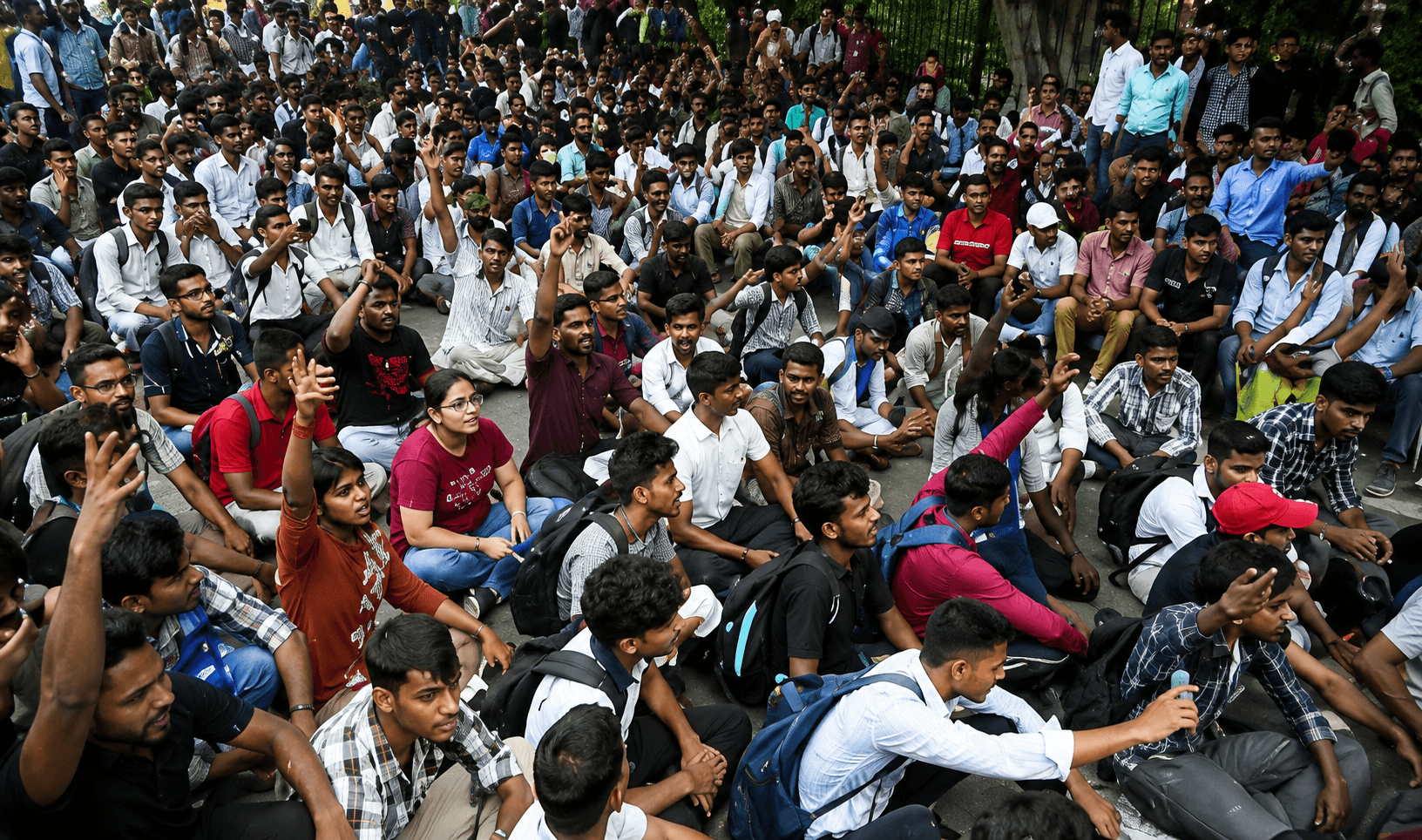
A day of dual tracks: street confrontation and closed-door talks
Monday brought two very different scenes to Delhi within hours of each other: a large protest march toward Parliament that police met with barricades, tear gas, and lathicharge, and a separate, "cordial" meeting between protest leaders and Union Health Minister and BJP President JP Nadda that ended with a written memorandum and an appeal to stand down.
Who's behind the protest
The demonstrations are being led by the Cockroach Janta Party (CJP), a satirical political movement founded on May 16, 2026 by political communications strategist Abhijeet Dipke, a former AAP staffer. CJP was born directly out of controversy: a day earlier, Chief Justice of India Surya Kant had remarked during a Supreme Court hearing that unemployed youth were "like cockroaches" who "don't get any employment," prompting Dipke to launch what he called a platform for all the "cockroaches" — self-described as unemployed, chronically online, and "able to rant professionally." What began as satire evolved into a genuine protest vehicle: CJP's campaign against alleged irregularities in the NEET-UG 2026 medical entrance exam began on June 6 and has since expanded to other cities, folding in complaints about CBSE Class 12 portal glitches and delays in the CUET exam as evidence of what the group calls systemic failure in India's examination system.
Sonam Wangchuk's hunger strike and hospitalization
Ladakhi engineer-educator and climate activist Sonam Wangchuk joined the movement and went on a hunger strike that ran 23 days before his health deteriorated. He was admitted to Delhi's Safdarjung Hospital on July 18 after doctors raised concerns over dehydration, low potassium levels, and elevated ketone levels — with reports from opposition leaders describing his removal from the protest site that day as forceful. Dipke himself began a separate indefinite hunger strike after Wangchuk's hospitalization, ending it only after an appeal from Wangchuk and from the father of a NEET aspirant, Riya Thapa, who died by suicide following the exam controversy. On the morning of the march itself, Wangchuk submitted a handwritten letter to hospital administrators asking for temporary leave to join the "Sansad Chalo" march, stating his vitals were normal and he was "feeling very fine."
The march to Parliament
Thousands of students, youth, and supporters gathered at Jantar Mantar on Monday — the first day of Parliament's Monsoon Session — for the CJP's "Sansad Chalo" (Chalo Sansad) march, led by Dipke alongside Wangchuk's wife, Gitanjali Angmo. Delhi Police said no permission had been granted for the march and moved to stop protesters with heavy barricading; when demonstrators pushed through in places, police and the Rapid Action Force responded with multiple rounds of tear gas and lathicharge, while some protesters reportedly hurled bottles and other objects at security personnel. CJP founder Dipke was among those detained, and the group said internet services had been shut down in parts of the city, complicating efforts to share updates from the ground. Samajwadi Party MP Akhilesh Yadav was among opposition figures who criticised the police response, saying officers in plainclothes had mistreated students and youth at the protest.
The meeting with JP Nadda
Separately, a CJP delegation held talks with Nadda that began around 11:50 am. In a post on X, Nadda described the meeting as cordial, saying the delegation first held detailed verbal discussions before submitting a written memorandum at around 4 pm; he said the initiative for talks had come from the protesters themselves. The memorandum outlined three central demands: the unconditional release of Sonam Wangchuk from hospital, without restrictions on his movement; the resignation or removal of Union Education Minister Dharmendra Pradhan; and compensation of ₹1 crore for the families of NEET aspirants who died by suicide following the paper leak controversy. Nadda, for his part, appealed to protesters to end their sit-in and "help restore normalcy," saying he would need time to take the demands to the party leadership.
Where things stand
Following the meeting, Wangchuk ended his 23-day hunger strike, marking what several outlets described as a breakthrough after weeks of standoff — though none of the memorandum's core demands have been met by the government as of this writing, and Dharmendra Pradhan remains in his post. Whether the meeting proves to be a genuine turning point or simply a pause in an agitation that has already run for six weeks and drawn in hunger strikes, mass detentions, and repeated use of force is likely to become clear only in the coming days, as Parliament's Monsoon Session gets underway and the government decides how — or whether — to respond formally to the CJP's demands.