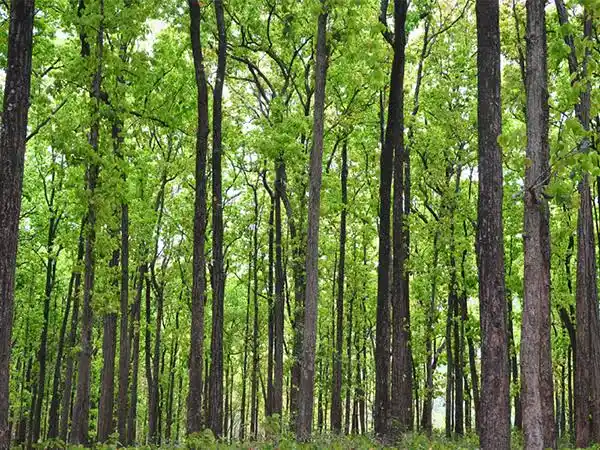
Sal Tree Crisis: 17,000+ Trees to Be Felled in Dehradun and Kalsi to Contain Beetle Outbreak
Background and Context
The Sal borer (Hoplocerambyx spinicornis) has been wreaking havoc on the Sal tree population in the Dehradun and Kalsi forest divisions of Uttarakhand, India. The Sal borer beetle lays eggs under the bark of the tree, and its larvae feed on the inner tissues, disrupting the flow of water and nutrients, ultimately leading to the tree's demise. The recent decision to fell approximately 17,000 Sal trees has sparked debate among experts and environmentalists, highlighting the need for a comprehensive approach to forest management.
Monoculture and the Sal Borer Outbreak
The widespread destruction caused by the Sal borer outbreak is linked to the practice of monoculture, where a single species of tree is planted on a large scale. This approach has been widely adopted in India's forest management policies, with the Sal tree being a primary species. However, experts argue that monoculture creates an ecological vulnerability, making forests more susceptible to insect outbreaks and disease.
Dr. Anuradha Dutta, a forest ecologist at the Wildlife Institute of India, notes, "Monoculture forests lack the diversity and resilience that mixed forests possess. The uniform age structure and species composition in these forests create an ideal environment for pests like the Sal borer to thrive."
The Felling Strategy: A Short-Term Solution?
The decision to fell the affected trees is seen as a short-term solution to contain the outbreak. Forest officials claim that this method is currently the most effective way to break the life cycle of the insects. However, experts argue that this approach may not address the underlying issue of monoculture and may even exacerbate the problem in the long run.
Dr. Vinay Prasad, a forest entomologist at the Indian Council of Forestry Research and Education, suggests, "While felling the trees may provide temporary relief, it does not address the root cause of the problem. We need to adopt a more holistic approach that promotes mixed forestry and encourages the growth of diverse vegetation."
Way Forward: Mixed Forestry and Sustainable Practices
The Sal borer outbreak serves as a wake-up call for policymakers and forest managers to reassess their approach to forest management. Adopting mixed forestry practices and promoting sustainable forest management can help mitigate the risk of future ecological disasters.
Implementation of mixed forestry will require a shift in policy and a commitment to long-term planning. This includes the creation of forest patches with diverse age structures, species compositions, and vegetation types. Additionally, sustainable forest management practices such as selective logging, reforestation, and habitat restoration can help maintain the health and resilience of forests.
The decision to fell 17,000 Sal trees is a critical step towards containing the outbreak, but it also presents an opportunity to rethink our approach to forest management. By adopting mixed forestry and sustainable practices, we can create more resilient forests that are better equipped to withstand the challenges of a changing climate and emerging ecological threats.