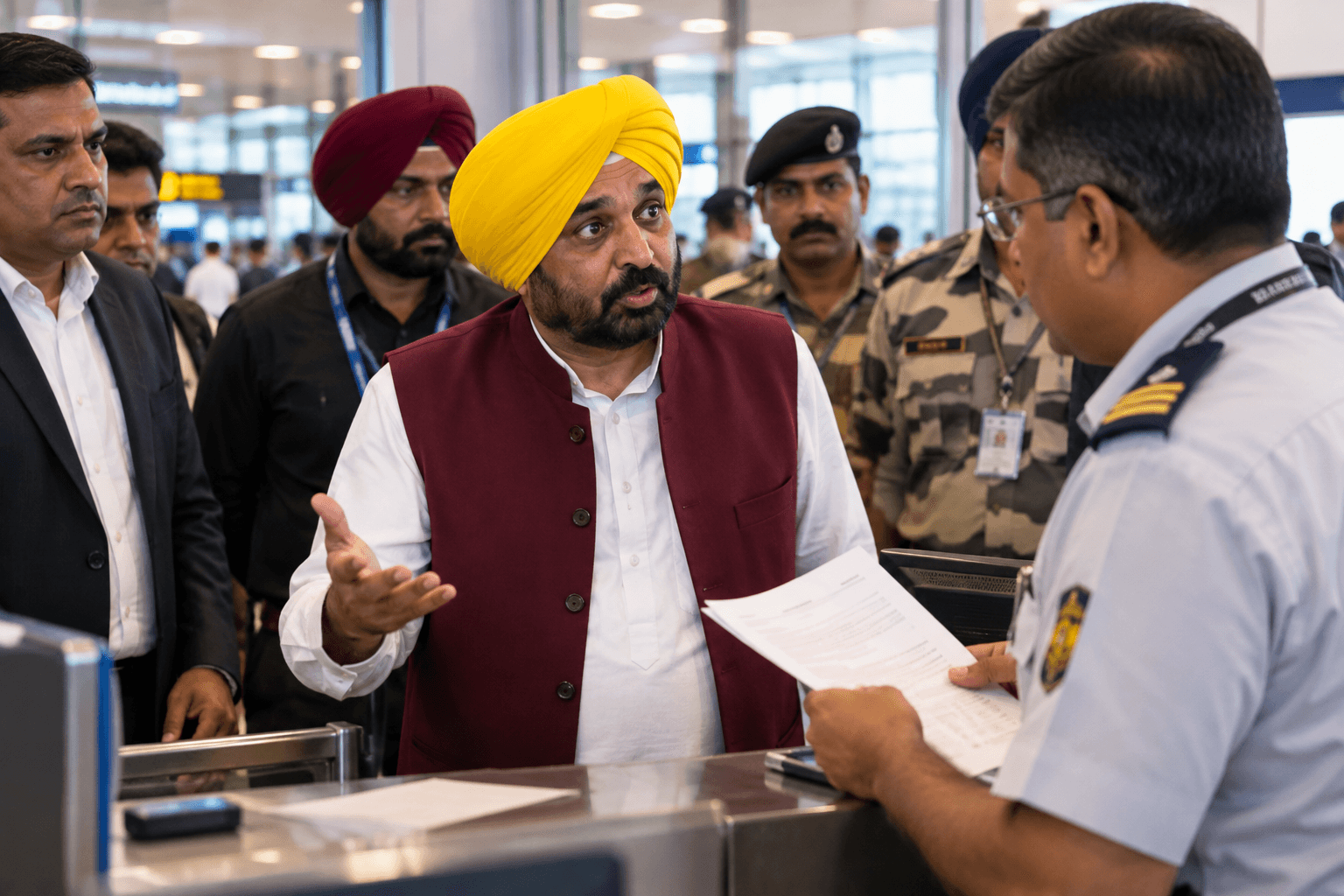
Punjab’s chief minister Bhagwant Mann was held for three hours at Delhi’s Indira Gandhi International Airport on a routine security check and later slapped with a Rs 50,000 fine for allegedly violating airport regulations. The Aam Aadmi Party (AAP) has framed the episode as a calculated attempt by the BJP‑led centre to humiliate the newly elected chief minister and to send a political warning to the opposition‑run state. The incident, which unfolded on a busy Thursday morning, has already ignited a flurry of statements from both sides, raising questions about the intersection of security protocols, federal politics, and the symbolic weight of administrative gestures.
Key Context & Background
Mann, a former comedian turned politician, leads the AAP government that swept the 2022 Punjab assembly elections on an anti‑corruption and farmer‑friendly platform. His tenure has been marked by aggressive subsidies, a push for water‑resource reforms, and a vocal stance against the central government’s agricultural policies. The BJP, which has struggled to regain a foothold in Punjab since the 2014‑19 era, views Mann’s administration as a direct challenge to its national narrative, especially on issues like farm laws and the controversial “Khalistan” discourse.
The detention occurred against a backdrop of escalating tension between Delhi and Chandigarh. Earlier this year, the centre’s Ministry of Home Affairs issued a series of notices to Punjab officials over alleged irregularities in the implementation of central schemes, a move AAP described as “politically motivated scrutiny.” Moreover, the airport incident coincides with a series of high‑profile detentions of opposition leaders across the country, fueling a perception among critics that security agencies are being leveraged as tools of political coercion.
Legal and Procedural Dimensions
Under the Directorate General of Civil Aviation (DGCA) regulations, any individual who fails to produce a valid air‑passenger security clearance can be detained and fined. Airport officials claim that Mann’s security pass had expired, prompting the three‑hour hold. Legal experts caution that while the law is clear, the discretionary power exercised by security personnel often lacks transparent oversight, creating room for selective enforcement. The Rs 50,000 challan, though modest in monetary terms, carries a symbolic sting that can be amplified in a politically charged environment.
Mann’s legal team has filed a petition in the Delhi High Court seeking a stay on the fine and an inquiry into the procedural propriety of the detention. If the court finds procedural lapses, it could set a precedent for challenging similar actions against political figures, potentially prompting a review of airport security protocols for elected officials nationwide.
Broader Implications & Future Impact
Beyond the immediate legal tussle, the episode may reshape the political calculus in Punjab and other opposition‑run states. AAP’s narrative of “central humiliation” could galvanize its base, especially in rural constituencies still sensitive to perceived affronts to state dignity. Conversely, the BJP may use the incident to underscore its commitment to uniform security enforcement, framing any dissent as an attempt to undermine law and order.
The incident also spotlights the broader debate over federalism in India, where administrative tools—ranging from tax assessments to security checks—are increasingly weaponized in partisan battles. Analysts warn that if such tactics become normalized, they could erode public trust in institutions meant to be apolitical, deepening regional polarization. In the medium term, the controversy may prompt the central government to revisit the guidelines governing the movement of state ministers, potentially leading to stricter documentation requirements that could either level the playing field or further entrench bureaucratic hurdles for opposition leaders.